
Written by: Paul Foster, Founder, CEO, OnePlan
A New Era For Event Safety
The Terrorism (Protection of Premises) Act 2025, commonly known as Martyn’s Law, is named in recognition of Martyn Hett, one of the 22 victims of the Manchester Arena attack in 2017. His mother, Figen Murray OBE, led the campaign for the legislation from 2019 onward. Her persistence turned a public petition into an Act of Parliament.
The Act received Royal Assent on 3 April 2025. Enforcement is expected from spring 2027, after an implementation period of at least 24 months from Royal Assent. If you organize events in the UK, Martyn’s Law will very likely apply to you. The time to prepare is now, before the SIA’s inspectors arrive on site.
Who Martyn’s Law Covers
The Act applies to premises and events in England, Wales, Scotland, and Northern Ireland that are publicly accessible and used for a Schedule 1 purpose. Schedule 1 lists 17 categories, including entertainment and leisure, sports grounds, food and drink venues, hotels, places of worship, transport stations, and public authorities.
Premises can be indoors, outdoors, or mixed-use. Racecourses, showgrounds, zoos, and theme parks are all explicitly covered. Festivals, marathons, community events, and one-off outdoor gatherings are in scope if they meet the capacity threshold.
The responsible person is the individual, organisation, or company with control of the premises for its principal Schedule 1 use. For an event, this is the person with control of the premises in connection with their use for that event. Legal responsibility stays with that responsible person, although they can delegate tasks.
Capacity is assessed by whether there is a reasonable expectation that the relevant number of individuals may be present on the premises at the same time, and that figure must include staff and workers. You can calculate capacity using fire safety occupancy figures, historic attendance data, or another justified method.
The Two Tiers Of Martyn’s Law
The Act uses a tiered approach based on the greatest number of individuals, including staff, reasonably expected to be present at the same time. The table below summarises the main differences between the two tiers.
| Requirement | Standard Tier (200–799 People) | Enhanced Tier (800+ People) |
|---|---|---|
| Notify the SIA | Yes | Yes |
| Public protection procedures (evacuation, invacuation, lockdown, communication) | Yes | Yes |
| Public protection measures (monitoring, movement, physical security, information security) | No | Yes |
| Documented compliance submitted to the SIA | No | Yes |
| Designated senior individual | No | Yes (where responsible person is an organisation) |
| Maximum penalty for non-compliance | £10,000 (plus up to £500/day) | Greater of £18 million or 5% of global revenue (plus up to £50,000/day) |
Standard Tier (200–799 People)
Standard tier premises must notify the SIA, put the four public protection procedures in place, and ensure staff are aware of and ready to implement them. They do not need physical security measures or a formal terrorism risk assessment, and they do not submit a compliance document to the SIA. The Home Office estimates standard tier compliance at around £330 a year, mostly in staff time.
Enhanced Tier (800+ People)
Enhanced tier premises must meet all standard tier requirements. They must also implement public protection measures across monitoring, movement, physical safety and security, and security of information. They need to document their compliance and submit that document to the SIA within 30 days of any revision. Where the responsible person is an organisation, they must designate a senior individual.
An event is not automatically a qualifying event merely because 800 people attend. It must meet six criteria, including taking place at qualifying premises for event purposes, being accessible to the public, reasonably expecting 800 or more people at the same time, having qualifying entry checks such as payment or tickets, and not taking place at excluded premises.
Key Safety Procedures Under Martyn’s Law
All in-scope premises and events must plan for four core procedures. These procedures must be documented and shared with staff so they can act on them immediately. Each procedure focuses on a different stage of an incident.
- Evacuation: moving people safely out of the premises or event, or a part of it, and away from danger. For a festival, this means clearly marked exit routes, assembly points, and a plan for moving large crowds off-site quickly.
- Invacuation: moving people away from danger to a safer place within the premises or event, including bringing people inside from outside. At an outdoor event, this could mean directing crowds into a backstage compound or a solid structure.
- Lockdown: securing the premises or event to prevent individuals entering or leaving, for example by locking doors, closing shutters, or using barriers to restrict an attacker’s movement. A stadium lockdown plan would identify which access gates to close and in what sequence.
- Communication: providing information to people at the premises or event, alerting them to danger quickly and giving clear instructions to remain in place or move away where safe.
The Act does not require physical alterations or specific equipment for these procedures. In some contexts, however, it may be reasonably practicable to add physical measures to support them.
Timeline And Current Status
Here is the current position as of September 2026.
- 3 April 2025: The Terrorism (Protection of Premises) Act 2025 received Royal Assent.
- 15 April 2026: The Home Office published statutory guidance to support implementation.
- 15 June 2026: A small number of provisions came into force, switching on the SIA’s duty to prepare its regulatory guidance, but no duties for venues yet.
- Autumn 2026: The SIA plans to publish its final Section 12 guidance following consultation.
- Spring 2027: Enforcement is expected to begin.
As of July 2026, the duties under Martyn’s Law have not yet commenced, and venues have no legal obligations before commencement. The SIA is still encouraging all those who may be in scope to start preparing now. The implementation window is the time to sort your site plans, procedures, and staff training, rather than rushing in the final month.
How To Prepare: A Step-By-Step Guide For Event Organizers
Preparation for Martyn’s Law can follow a clear, practical checklist. Use these steps to move your event toward compliance with confidence.
- Determine your tier. Count your expected peak attendance, including all staff and volunteers. If that figure is 200 or above, you fall within scope. If it reaches 800 or above, you fall within the enhanced tier. Use fire safety occupancy figures, historic ticketing data, or another justified method.
- Conduct a terrorism risk assessment. The Act assumes that a terrorist attack might occur anywhere, so requirements do not depend on the perceived likelihood at specific premises. Consider which scenarios are plausible at your site and what impact they could have.
- Develop your public protection procedure document. Write your evacuation, invacuation, lockdown, and communication procedures in clear, plain language. This document forms the backbone of your compliance. For enhanced tier premises, it must also be submitted to the SIA.
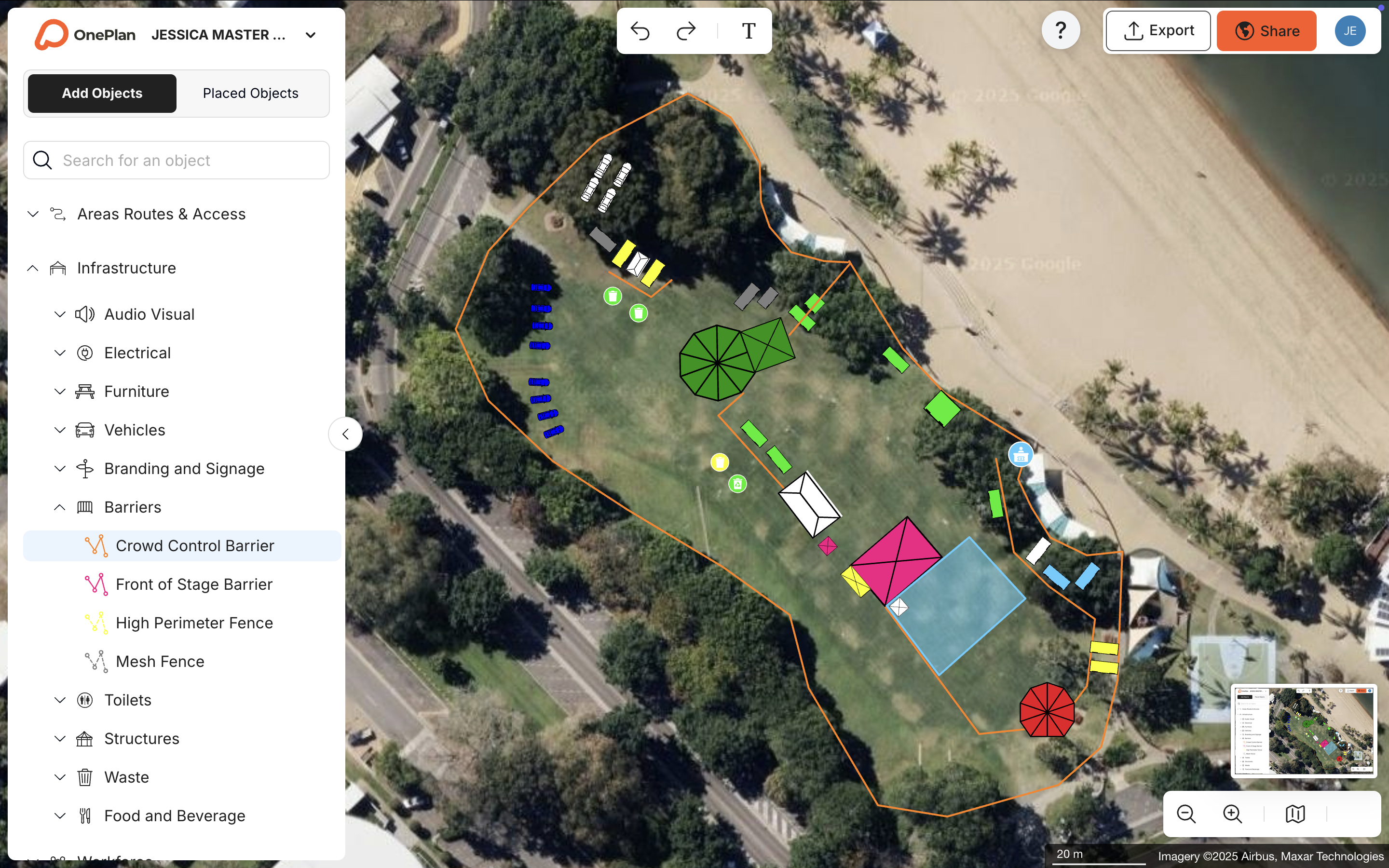
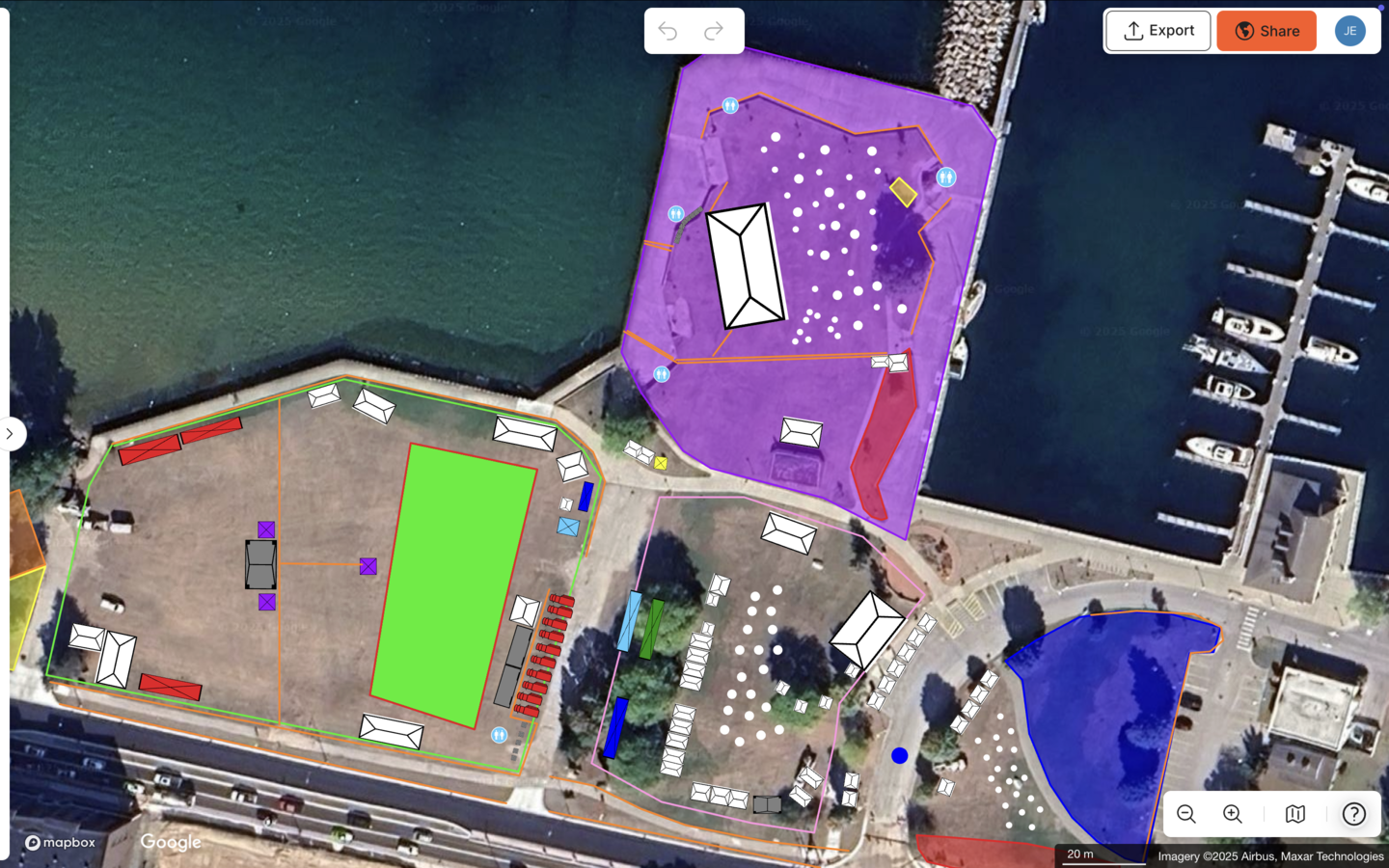
- Create an accurate, to-scale site plan. Your procedures only work when they sit on a clear plan. Map evacuation routes, assembly points, access gates, lockdown barriers, and communication points accurately so staff can act under pressure. This is where OnePlan helps. OnePlan’s browser-based platform lets you drag and drop thousands of event-specific objects onto a live satellite map, all to scale. These objects include crowd barriers, fencing, tents, signage, and entry and exit points. Once your layout is in place, the area and perimeter calculator shows exactly how much space you have. The standing crowd capacity calculator lets you outline any crowd area and instantly see how many people it can safely hold. To plan how crowds move in and out, use OnePlan’s exit flow calculator and arrival calculator to model ingress and egress before event day. The auto-generated Bill of Quantities turns your finished map into an exportable inventory, listing items such as meters of crowd barrier, numbers of portable toilets, and steward positions for procurement and Safety Advisory Group meetings.
- Train your staff. No specific paid training course is mandated, but staff with responsibilities for implementing procedures must understand the procedures, their role, and how to carry it out effectively. ProtectUK provides free, government-approved counter-terrorism training, including ACT Awareness and SCaN (See, Check and Notify).
- Engage with local authorities and Safety Advisory Groups. In the UK, Safety Advisory Groups bring together local authorities, police, fire, and medical services to review event safety plans. An accurate, to-scale OnePlan site map, exportable as a high-resolution print-ready file, gives every stakeholder a clear shared picture of your event and supports faster, better-documented approvals.
- Keep your plan live and up to date. Martyn’s Law creates an ongoing duty, not a one-off task. Enhanced tier premises must keep their compliance document under review and provide it to the SIA within 30 days of any revision. OnePlan’s real-time collaboration means your operations, security, medical teams, and external partners all work from one live plan, so updates are instant and version confusion disappears.
Frequently Asked Questions
What Is The Difference Between Martyn’s Law And The Protect Duty?
They refer to the same legislation. “Protect Duty” was the working name used during consultation and pre-legislative scrutiny. “Martyn’s Law” is the common public name, in honour of Martyn Hett. The official legal title is the Terrorism (Protection of Premises) Act 2025. All three terms describe the same law.
Does Martyn’s Law Apply To My Small Community Event?
Martyn’s Law applies if you can reasonably expect at least the standard tier threshold of people, including staff and volunteers, to be present at the same time. The test focuses on realistic peak attendance rather than theoretical venue capacity. If your community event regularly draws that level of attendance at its busiest point, you fall within scope for the standard tier. If you feel unsure, use historic attendance data or fire safety occupancy figures to calculate your expected peak number.
What Are The Penalties For Non-Compliance?
The Security Industry Authority (SIA) is the sole regulator for Martyn’s Law and follows a “support first” approach, issuing compliance notices before financial penalties. The comparison table above sets out the maximum penalties for each tier, including daily fines for ongoing non-compliance. Providing false or misleading information to the SIA is a criminal offence under the Act for all tiers.
How Do I Calculate My Event Capacity?
Capacity is assessed against your peak expected attendance, counting everyone on site at the same time, including attendees, staff, volunteers, contractors, and vendors. Accepted methods include fire safety safe-occupancy figures, historic attendance data, or another justified method you can explain to the SIA. For modeling how many people a specific crowd area can safely hold, OnePlan’s standing crowd capacity calculator lets you outline any zone on your to-scale site map and instantly see its capacity. For arrival and exit flow, you can use OnePlan’s free arrival calculator and exit calculator to estimate queue times and exit capacity.
What Is A Public Protection Procedure Document?
A public protection procedure document sets out your written procedures for the four core responses required under Martyn’s Law: evacuation, invacuation, lockdown, and communication. For standard tier premises, this document acts as your internal reference and the basis for staff training, and it does not need to be submitted to the SIA. For enhanced tier premises and qualifying events, the document must also cover your public protection measures, include an assessment of how those procedures and measures reduce vulnerability and risk of harm, and be submitted to the SIA, with updates provided within 30 days of any revision. The SIA’s inspectors will check that the procedures in the document are in active use and familiar to the staff who rely on them.
Next Steps For Event Organizers
Martyn’s Law is scheduled to come into force in spring 2027. If your events or venues expect attendance at or above the standard tier threshold, including staff, the law will apply to you. The two-tier structure is clear, the procedures are practical, and the implementation window gives you time to prepare thoroughly. Organizers who start now will move through compliance smoothly, while late starters will face unnecessary pressure.
Accurate, to-scale site plans sit at the heart of every public protection procedure. OnePlan has powered more than 200,000 events across 150 countries, from local festivals and community fairs to Formula 1 circuits and the Paris 2024 Olympic Games. Event teams use OnePlan as a visual, collaborative planning tool to design safe events together. Your first event is free.