
Written by: Paul Foster, Founder, CEO, OnePlan
Key Takeaways
- Protect Duty (Martyn’s Law) under the Terrorism (Protection of Premises) Act 2025 becomes a legal requirement for parks and recreation events with controlled entry and 200+ attendees, with enforcement expected no earlier than spring 2027.
- Events fall into Standard Tier (200–799 attendees) or Enhanced Tier (800+ attendees), each with distinct compliance obligations including SIA notification, risk assessments, and public protection procedures.
- Compliance follows a clear process: determine scope, notify the SIA, appoint a senior individual (enhanced tier), complete terrorism risk assessments, put security measures in place, train staff, and keep thorough records.
- Free training resources such as ACT Awareness e-Learning, SCaN, and the ProtectUK Roadmap help event teams build staff competence and meet documentation requirements.
- OnePlan provides the to-scale mapping and documentation tools parks and recreation teams need to prepare for Protect Duty, so you can see how it supports your compliance planning in a quick 15-minute demo.
The New Reality For Parks And Recreation Events
The Terrorism (Protection of Premises) Act 2025 received Royal Assent on 3 April 2025, named in memory of Martyn Hett, one of the 22 victims of the 2017 Manchester Arena attack. The Home Office published statutory guidance on 15 April 2026, giving those in scope a practical framework to prepare. The implementation period is at least 24 months from Royal Assent, so the earliest lawful commencement is after 3 April 2027.
This Act is a legal framework designed to protect communities, staff, and visitors at publicly accessible locations. It goes far beyond a simple paperwork exercise. Parks and recreation teams that begin preparing now will be better placed for smoother Safety Advisory Group (SAG) approvals and a more confident event-day operation.
Plan your next event the easy way. Get started free at OnePlan, where your first event is on us, or book a 15-minute demo to see OnePlan in action.
Does Protect Duty Apply To Your Park Event?
Parks, gardens, and open-air recreation premises are excluded from scope if they are open-access and have no measures to check or restrict entry. Once a park event adds ticket checks, fencing, or gated access, it may fall within scope.
Use this checklist to determine whether your event is in scope:
- The event is ticketed or has a controlled entry point such as fencing, gated access, or ticket checks.
- Two hundred or more people, including staff, could be present at the same time.
- The event is publicly accessible.
If all three apply, your event is likely in scope. Temporary structures at an event are assessed separately; each area with entry controls must independently meet the criteria. Local authorities may also hold duties for permanent facilities with controlled access.
Standard And Enhanced Tiers For Park Events
| Requirement | Standard Tier (200–799) | Enhanced Tier (800+) |
|---|---|---|
| Notify the Security Industry Authority (SIA) | Yes | Yes |
| Public protection procedures (evacuation, invacuation, lockdown, communication) | Yes | Yes |
| Terrorism risk assessment | Yes | Yes (more detailed) |
| Appoint a designated senior individual | No | Yes |
| Written compliance document | No | Yes |
| Physical security measures (CCTV, bag searches, vehicle checks) | Not required | Yes, where reasonably practicable |
The standard tier requires notification to the SIA and appropriate public protection procedures, with no requirement for physical security measures. Qualifying events with controlled entry and 800 or more people expected at the same time are subject to the same requirements as enhanced tier premises.
“Reasonably practicable” means proportionate: the responsible person weighs the cost, time, and difficulty of implementation against the objective of reducing physical harm. Even events below 200 attendees benefit from clear, well-planned security practices.
Step-By-Step Compliance For Parks And Recreation Events
The compliance journey for a parks and recreation event follows a clear sequence. Each step builds on the last, and the guidance below focuses on temporary, outdoor settings.
- Determine scope. Use the checklist above to confirm whether your event falls within the standard or enhanced tier. This decision shapes every later step.
- Notify the SIA. For qualifying events, notify the SIA within 14 days of the event being first publicised after commencement. Because the SIA needs to know which events fall under the Act, you submit this notification through the SIA’s online portal.
- Appoint a Senior Responsible Individual (enhanced tier only). This must be someone with management or control of the organisation, rather than a lower-level employee, so they can direct resources and make decisions.
- Conduct a terrorism risk assessment. Use the framework in the next section to assess your specific site and event layout.
- Implement protective security measures. Apply the findings from your risk assessment and use the practical measures section below as a checklist.
- Train staff and volunteers. Draw on the training resources listed later so staff understand procedures and can act confidently.
- Document everything. Enhanced tier responsible persons must document procedures and measures and provide this to the SIA. Good records also support SAG meetings and internal reviews.
How To Conduct A Terrorism Risk Assessment For An Outdoor Event
A terrorism risk assessment for a temporary outdoor event works best as a structured, site-specific process. The framework below is tailored to park settings with open boundaries and multiple access points.
- Walk the site. Identify all entry and exit points, including informal gaps in fencing or hedgerows.
- Assess crowd dynamics. Map density, flow, and pinch points, especially at ticket gates and stage fronts.
- Evaluate proximity risks. Note surrounding roads, public transport routes, and vehicle access points next to the event perimeter.
- Identify high-profile attractions. Stages, VIP areas, and children’s zones present elevated risk and need specific mitigations.
- Consider hostile reconnaissance. Assess what an attacker could observe from public vantage points around the park.
- Document vulnerabilities and mitigations. Record each risk, its likelihood, and the control measure in place.
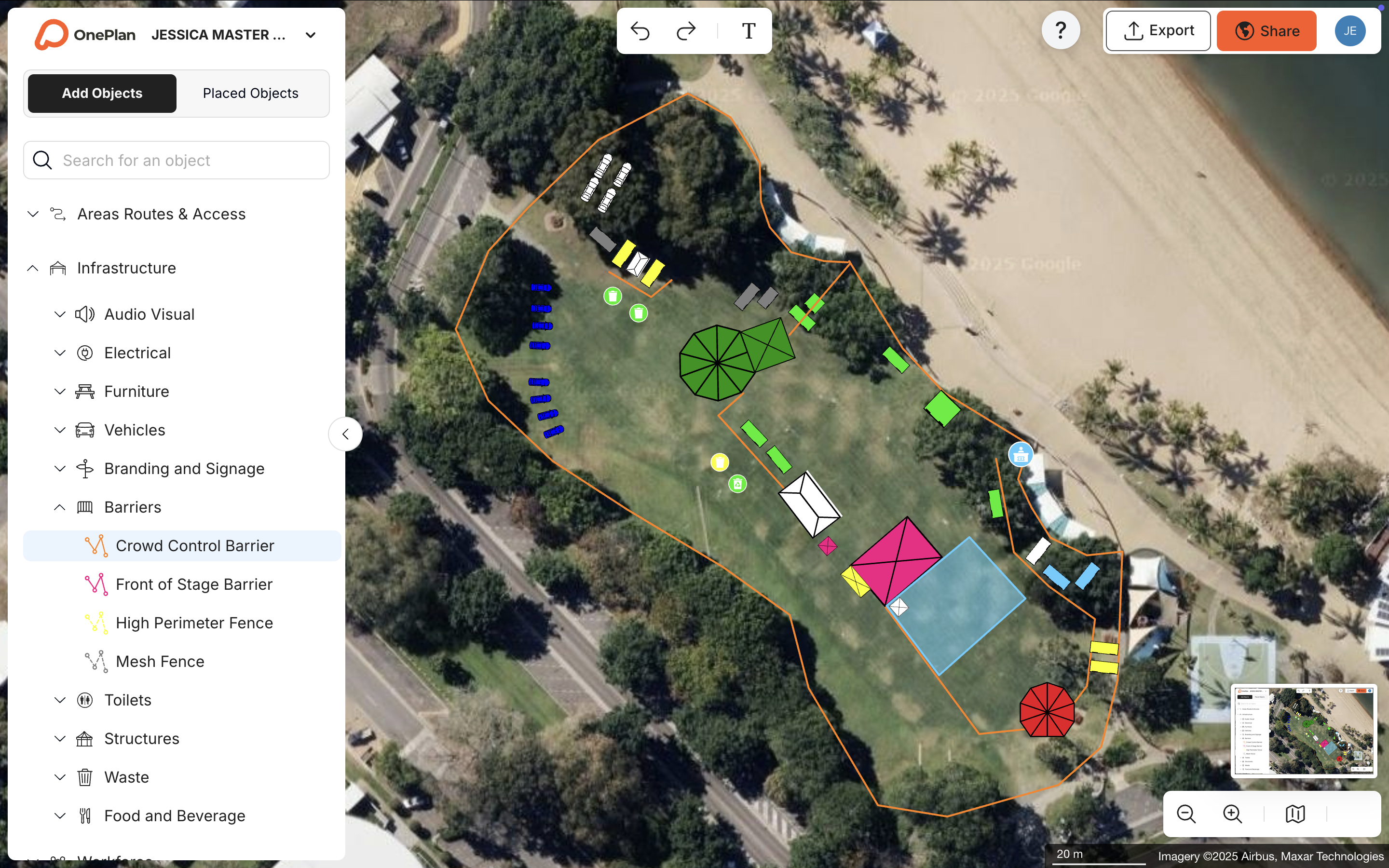
A to-scale site plan is essential for this process. OnePlan’s map-based planning tools let you outline crowd areas, place barriers and fencing, mark CCTV points, and plot vehicle approach routes. All of this happens on a live, geo-accurate satellite map. The result is a visual risk assessment you can share directly with your Safety Advisory Group and local police. South Fayette Township’s parks and recreation team moved from Google Earth to OnePlan to plan community events, gaining more current imagery and greater planning accuracy. Always consult your local authority and Safety Advisory Group when developing your assessment.
Practical Security Measures For Outdoor Events
Enhanced tier events must take steps to reduce vulnerability to terrorism, such as having CCTV, bag search policies, or vehicle checks where appropriate. The measures below are examples, and your final approach should reflect event size, location, and your site-specific risk assessment.
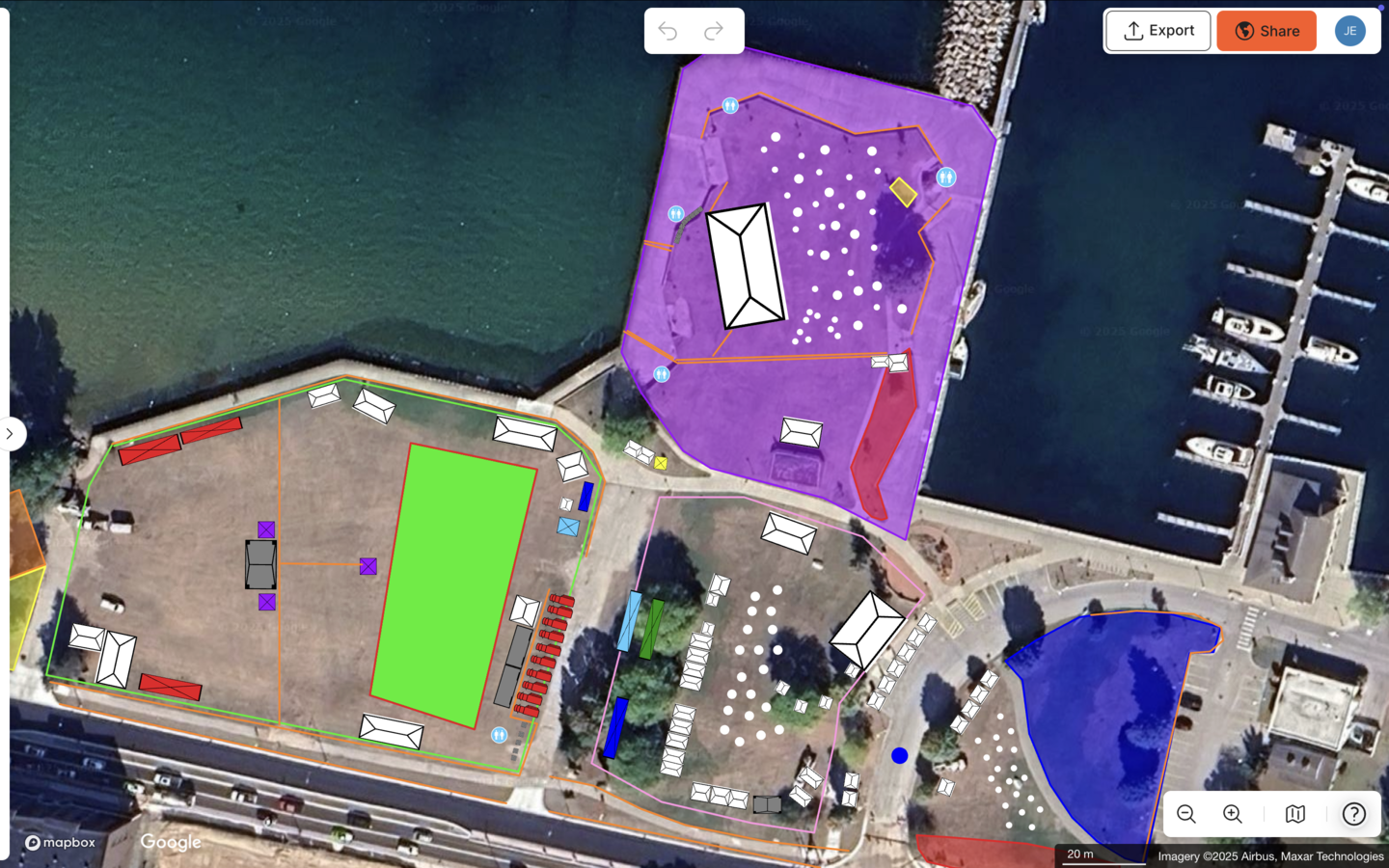
- Controlled entry points: Use fencing, barriers, and ticket checks to manage access and create a defined perimeter.
- Vehicle mitigation: Deploy bollards, planters, or barriers to prevent vehicle attacks at pedestrian entry points and crowd areas.
- Crowd management: Plan safe ingress and egress routes and avoid bottlenecks at gates and stage areas.
- CCTV and lighting: Consider temporary CCTV coverage and adequate lighting across the site perimeter and key areas.
- Evacuation planning: Establish clear evacuation routes and invacuation points, and make sure all staff know them.
- Staff deployment: Position security and stewarding staff at entry points, crowd areas, and vehicle access routes.
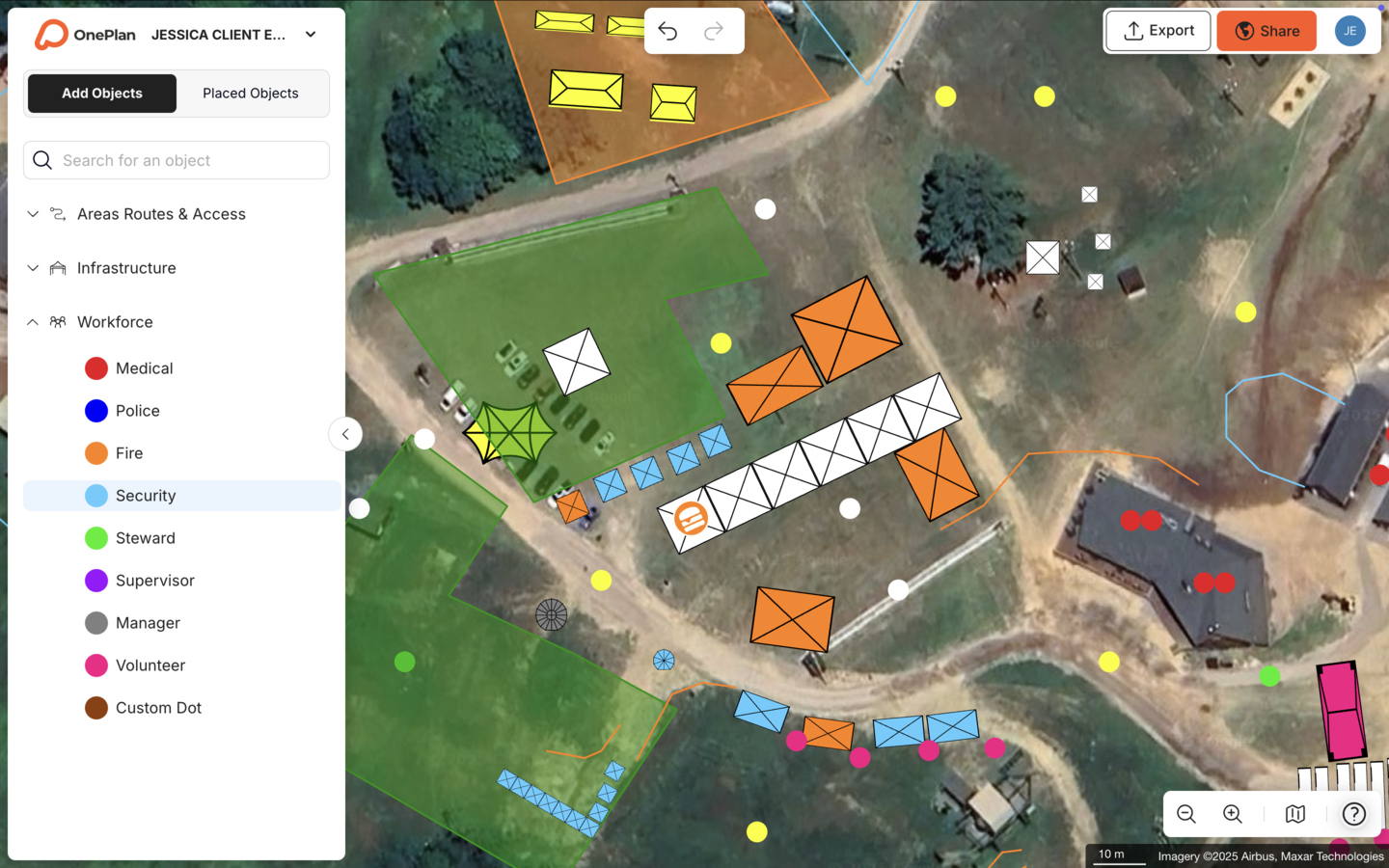
In OnePlan, you can place barriers, fencing, CCTV points, and staff positions directly onto a to-scale map of your park. The standing crowd capacity calculator lets you outline any area and instantly see how many people it can safely hold. This insight is critical for safety sign-off and SAG meetings. The auto-generated Bill of Quantities then turns your plan into an exportable inventory, so you know exactly how many meters of fencing or how many barriers to procure.
Protect Duty Training For Event Staff
The responsible person must ensure staff at qualifying premises or events are aware of public protection procedures and are competent in their role to deliver them effectively. There is no statutory requirement for a specific form of training, but awareness and competence must be demonstrable.
Free resources available to parks and recreation teams include:
- ACT Awareness e-Learning: A free, approximately 45-minute course covering suspicious activity, marauding attacker response, and security vulnerabilities. It suits all staff and volunteers. A refreshed version was released in June 2026 with improved accessibility and new filmed exercises.
- ACT Security e-Learning: A free, approximately 75-minute course for security operatives who need deeper understanding of the threat landscape and response actions.
- SCaN (See, Check and Notify): Helps staff spot suspicious behaviour and hostile reconnaissance. It suits public-facing roles including stewards and volunteers.
- ProtectUK Roadmap: A free, interactive step-by-step guide for anyone responsible for people in an organisation, helping them understand vulnerabilities and take proportionate steps toward counter-terrorism preparedness.
For enhanced tier events, training needs and evidence of delivery must be documented. Keep attendance records, briefing notes, and scenario exercise logs as part of your compliance documentation.
How OnePlan Helps You Comply
OnePlan is a visual, to-scale way to plan event sites, and for Protect Duty compliance it acts as the operational backbone of your planning and documentation process. Trusted across 200,000 events in 150 countries, OnePlan gives parks and recreation teams the tools to move from a blank map to a fully documented, shareable compliance plan.
- Create a to-scale site plan with entry points, fencing, barriers, evacuation routes, CCTV positions, and staff deployment, all on a live satellite map.
- Use the standing crowd capacity calculator to determine safe capacities for each zone and support your risk assessment documentation.
- Collaborate with stakeholders such as police, Safety Advisory Groups, and security teams on a single live plan, with real-time editing and secure share links.
- Export high-resolution maps and a Bill of Quantities for SAG submissions, permit applications, and procurement.
The same to-scale planning tools that helped South Fayette Township’s parks and recreation team, mentioned earlier, apply directly to Protect Duty compliance documentation. You can use one live plan to brief teams, evidence decisions, and respond quickly if layouts change.
Common Pitfalls And How To Avoid Them
Even well-prepared teams miss key obligations. The table below highlights frequent gaps and the practical fixes that help you close them before event day.
| Pitfall | Solution |
|---|---|
| Assuming the law does not apply to your events | Use the scope checklist early in planning; any controlled entry point and 200+ attendees triggers compliance |
| Failing to document risk assessments | Use OnePlan to create a visual, shareable record exportable for SAG and SIA submissions |
| Overlooking vehicle attack mitigation | Include vehicle barriers in your to-scale site plan from the earliest planning stage |
| Not training staff and volunteers | Use free ACT Awareness e-Learning and SCaN resources via ProtectUK and document attendance |
| Using static, non-scaled maps for compliance documentation | Switch to to-scale, map-based planning in OnePlan for accurate, professional outputs |
Frequently Asked Questions
What Is Protect Duty?
Protect Duty, also known as Martyn’s Law, is UK legislation under the Terrorism (Protection of Premises) Act 2025. It requires those responsible for publicly accessible premises and events to consider the threat of terrorism and implement proportionate protective security measures. The law is named in memory of Martyn Hett, one of the 22 victims of the 2017 Manchester Arena attack, and applies across England, Wales, Scotland, and Northern Ireland.
When Does Protect Duty Come Into Force?
The Act received Royal Assent on 3 April 2025, with a 24-month implementation period, so the earliest lawful commencement is after 3 April 2027. The Home Office also published statutory guidance in April 2026. There is currently no legal requirement to comply until commencement, but responsible persons are expected to use the implementation period to prepare. A statutory instrument setting out further information on the notification requirement was laid on 14 July 2026.
Does Protect Duty Apply To Small Community Events In Parks?
Protect Duty applies if the event has a controlled entry point, such as ticket checks, fencing, or gated access, and 200 or more people, including staff, are reasonably expected to be present at the same time. Open-access park events without any entry controls are excluded from scope. Once controlled access is introduced, the event may fall within the standard tier (200–799) or enhanced tier (800+).
What Is The Difference Between Standard And Enhanced Tier?
The standard tier applies to events where 200–799 people are expected at the same time. It requires notification to the Security Industry Authority and appropriate public protection procedures covering evacuation, invacuation, lockdown, and communication. No physical security measures are required. The enhanced tier applies to events where 800 or more people are expected, adding a requirement for a designated senior individual, a vulnerability assessment, a documented compliance document, and public protection measures, including physical security measures, where reasonably practicable.
What Free Training Is Available For Event Staff?
ProtectUK offers several free resources. ACT Awareness e-Learning is a free, approximately 45-minute course covering suspicious activity recognition and response, suitable for all staff and volunteers. A refreshed version launched in June 2026 with improved accessibility and new filmed exercises. ACT Security e-Learning provides deeper training for security operatives. SCaN (See, Check and Notify) helps staff identify hostile reconnaissance. The ProtectUK Roadmap is a free, interactive step-by-step guide to counter-terrorism preparedness for anyone responsible for people in an organisation. None of these require paid subscriptions, and completion certificates are available for documentation purposes.
Start Preparing Now
The compliance journey for parks and recreation events under Protect Duty follows a clear path. You determine whether your event is in scope, notify the SIA, conduct a terrorism risk assessment, implement proportionate security measures, train your staff and volunteers, and document everything. With enforcement expected no earlier than spring 2027, the preparation window is open, yet it will close faster than most teams expect.
OnePlan gives parks and recreation teams to-scale, collaborative planning tools to visualise vulnerabilities, plan mitigations, and produce the documentation that regulators and Safety Advisory Groups expect, all in one living plan. This article is intended as practical guidance only; always consult the official statutory guidance and your local authorities for advice specific to your event and location.