
Written by: Paul Foster, Founder, CEO, OnePlan
Key Takeaways
- Every outdoor festival crowd safety plan starts by calculating usable site area, then dividing by target density to set safe maximum attendance.
- A compliant plan covers four core sections: site layout and capacity, security and crowd spotters, emergency and medical response, and communication and weather protocols.
- Capacity calculations subtract non-audience space and apply density thresholds, with an 80% buffer recommended to create a safety margin.
- Effective crowd crush prevention relies on density monitoring, strategic barrier layouts, and trained spotters at high-pressure points.
- OnePlan turns this template into a to-scale, export-ready plan, and you can book a demo today to see how it streamlines festival safety planning.
The 4-Section Crowd Safety Plan Template
A compliant outdoor festival crowd safety plan covers four core areas that build into one complete document. Work through each section in sequence before your permit submission deadline.
- Site Layout and Capacity. Provide a to-scale map showing all zones, barriers, entry and exit points, and calculated standing capacity for each crowd area.
- Security and Crowd Spotters. Set staffing ratios, post assignments, supervisor structure, and spotter positions at high-density zones.
- Emergency and Medical Response. Mark first-aid post locations, vehicle access routes, evacuation corridors, assembly points, and tiered incident response levels.
- Communication and Weather. Document PA scripts, multi-channel alert protocols, weather trigger thresholds, and show-stop authority.
Plan your next event the easy way. See how OnePlan turns this four-section template into a to-scale, export-ready plan with your first event free or a 15-minute demo.
Calculating Safe Crowd Capacity for Outdoor Festivals
Safe crowd capacity starts with your gross site area in square feet. Subtract all non-audience space such as stages, production zones, sound towers, vendor footprints, first-aid posts, and any area without a direct sightline to the stage. The remaining figure is your usable audience area.
Apply a target standing density to that usable area to get your safe capacity. John J. Fruin's foundational crowd-density research and contemporary crowd-science guidance establish clear thresholds: free movement at low density, restricted movement at moderate density, and dangerous compressive forces at high density. Crowd-science research treats densities above approximately 6 persons per square meter as critical crush conditions, where forces can exceed 4,500 Newtons and compressive asphyxia becomes a lethal risk.
Build in a buffer by stopping entry at 80% of calculated capacity. This approach gives you a safety margin for unexpected surges. Always verify your final figures against local authority requirements, which vary by state and jurisdiction.
Once you have established your safe capacity ceiling, you need to confirm that your gates and exits can process people at that rate without creating dangerous queues. For gate throughput, use OnePlan's free arrival calculator to estimate queue length and ticket-check times, and the exit calculator to confirm your exit widths can clear the crowd within your target dispersal window. These tools provide a fast way to validate your ingress and egress assumptions before committing to a gate layout.
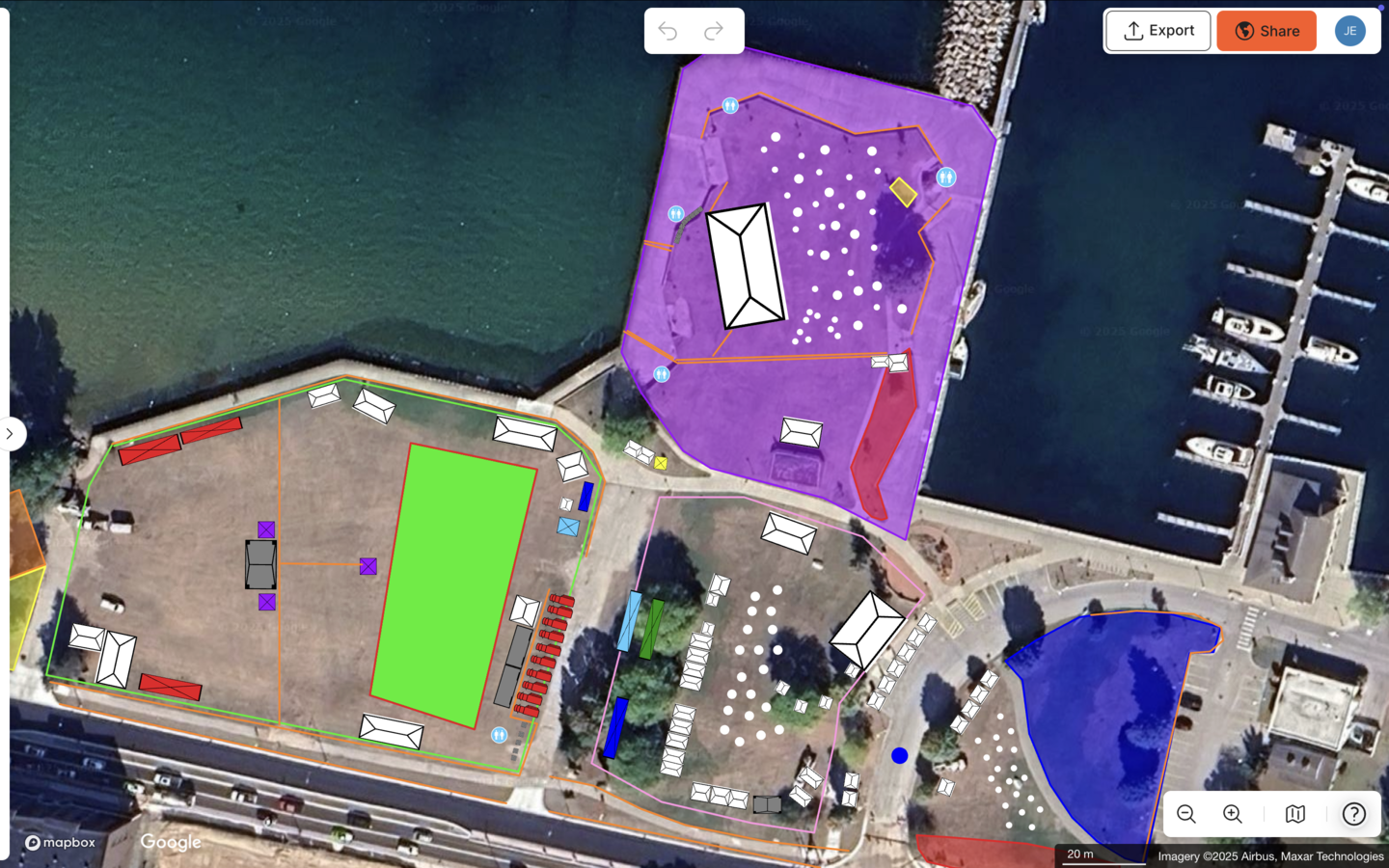
In OnePlan, you outline any crowd area on the map and the standing crowd capacity calculator returns a safe capacity figure instantly. That gives you a defensible number for permit submissions and safety authority meetings.
Turning a Festival Crowd Safety PDF into a Live Plan
A static PDF or Word document is a starting point, not a finished plan. Static files are not to scale, version control breaks down as soon as the file is emailed, and different departments such as security, medical, and operations quickly end up working from separate copies.
A more effective approach is to build your plan on a live, to-scale map and export a high-resolution PNG (up to A0, print-ready) for permit submission. OnePlan generates that export directly from the plan, along with a Bill of Quantities that lists every object placed, including barriers, fencing, toilets, and staff posts, as an exportable CSV for suppliers and contractors.
This live-map workflow is how multi-event festivals keep plans consistent across seasons. The Cheese & Chilli Festival, which runs four times a year with up to 9,000 attendees and over 120 vendors, uses OnePlan's crowd measurement, evacuation calculators, and emergency vehicle route tools for its risk assessments and management plans. As Simon Stewart of the Cheese & Chilli Festival put it: "OnePlan gives us reliable safety and planning information that supports our planning, operations and stakeholders."
Severe Weather Planning for Outdoor Events
ANSI ES1.7-2021 requires event organizers to conduct formal weather risk assessments covering forecasting, live monitoring, organizational hierarchy, and documented response actions. A weather annex therefore forms a non-negotiable part of any outdoor festival safety plan.
Your severe weather plan should include:
- Named roles for weather monitoring and show-stop authority, assigned to separate individuals. Separating these roles ensures that the person tracking conditions is not also making high-pressure decisions about stopping the show.
- Trigger thresholds tied to actual evacuation timelines for each crowd zone. These thresholds tell your decision-maker when to act, for example the 30/30 Rule: seek shelter immediately if lightning is seen and thunder heard within 30 seconds, and wait at least 30 minutes after the last thunder before resuming.
- Pre-scripted PA messages for each trigger threshold, including watch, warning, shelter, evacuation, and all-clear scenarios. Writing these in advance means wording is clear and consistent rather than improvised under duress.
- Multi-channel communication so every attendee receives the alert regardless of location on site. Use PA, LED screens, push notifications, SMS, and social media, with physical signage as a fallback.
- Professional meteorologist access, which provides expert interpretation of radar data and localized forecasts that free weather apps cannot match.
A DTN study found that more than 90% of weather-related decisions happen within 48 hours of the event. Your triggers and authority structure therefore need to be documented and rehearsed well in advance, not improvised on the day.
Security Guard Placement for Festivals
For large outdoor festivals, industry guidelines recommend a security baseline of roughly 1 guard per 25–50 guests at high-energy events. The Purple Guide recommends 1 steward per 100–150 attendees for higher-risk outdoor music events involving crowd movement, alcohol, and multi-zone layouts. These figures provide starting points, while your final numbers depend on crowd profile, alcohol licensing, event duration, and local authority conditions, which vary by state and jurisdiction.
Once you have calculated your total security headcount using these ratios, you need to distribute those staff across specific post types. Post assignments should cover:
- Entry screening lanes, typically 1–2 staff per lane plus 1 supervisor per entrance.
- Perimeter coverage, with approximately 1 perimeter staffer per 150 feet of boundary, including backstage and service roads.
- Stage-front barrier zones with dedicated crowd spotters.
- Roaming de-escalation teams, especially where alcohol is served, since alcohol at an event increases crowd-control staffing needs by 20–30%.
- Emergency exit paths, with 1 staffer per exit path plus 1 roaming supervisor with a radio.
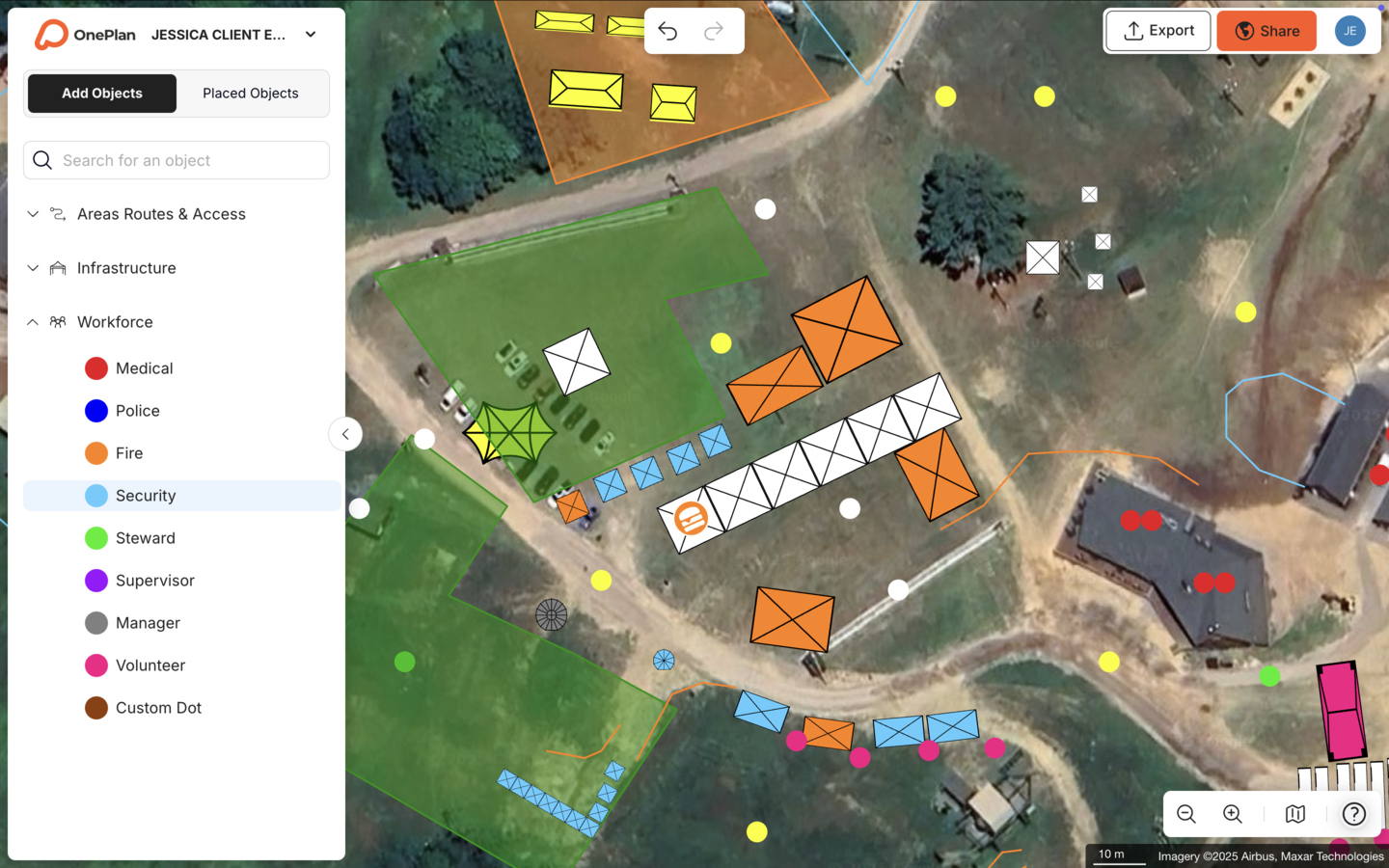
In OnePlan, security personnel appear as dots on the map with assigned names, shift times, and patrol routes. Every post is visible on the same live plan that operations and medical teams use, so you avoid juggling separate spreadsheets.
Crowd Crush Prevention at Outdoor Festivals
A dataset of worldwide crowd accidents from 1900 to 2024 compiled by Claudio Feliciani et al. identifies capacity exceedance and blocked exits as recurring factors in fatal crowd incidents. The 2024 Hathras satsang crush, where an event permitted for 80,000 attendees reportedly drew 250,000 people, caused 121 deaths, which shows a direct consequence of planning failure rather than bad luck.
Preventing these failures requires addressing both capacity exceedance and exit obstruction before the event opens. Crowd crush prevention at outdoor festivals relies on three controls working together:
- Density monitoring with pre-set action thresholds. Use alert thresholds at 70% capacity (advisory), 85% (warning), and 95% (action required), with pre-planned responses such as redirecting flow or closing entry to affected zones.
- Barrier layout that separates flows. Stage-front barriers, crowd-break barriers at regular intervals, and separate entry and exit routes prevent bidirectional bottlenecks. Emergency access corridors must remain clear at all times, with barricade gates designed for rapid removal without tools.
- Trained crowd spotters at high-pressure points. Spotters positioned at stage fronts, entry gates, and pinch points can identify density build-up before it becomes dangerous and radio event control to trigger a response.
Bearfoot Productions uses OnePlan to calculate crowd capacity visually for its 10,000-capacity festivals. As Director Tom Newton put it: "The calculations for crowd capacity and parking areas are great. It's nice to have a visual shape on our plan that shows me I can get 7,000 people at one person per square metre in there."
Emergency Evacuation Plan Template for Festivals
Effective emergency evacuation plans assign specific roles and responsibilities to staff, establish communication protocols for alerting attendees and coordinating staff, and specify procedures for contacting emergency services. Every evacuation plan must also include specific arrangements for attendees with disabilities or mobility impairments.
Your evacuation plan template should document:
- Who has authority to call an evacuation and at what trigger level. This decision-maker must be identified by name and role, with clear thresholds that remove ambiguity about when to act.
- Primary, secondary, and tertiary egress corridors with assessed capacity and gradient. Multiple routes ensure that if one path is blocked or compromised, the crowd has alternatives that can handle the load.
- Designated assembly points, screened for separation from incident zones, sufficient capacity, accessibility, and non-obstruction of emergency vehicle access. These locations are where evacuated attendees gather for headcounts and further instruction, so they must be safe, reachable, and large enough.
- A tiered response system that matches the response to the severity of the incident, with Tier 1 for localized incidents, Tier 2 for multi-department coordination such as weather holds, and Tier 3 for full evacuations requiring unified command with fire, police, and EMS.
- Layered communication to ensure every stakeholder receives the right information at the right time, using PA for attendees, warden direction at exits, radio updates for command, and direct contact with emergency services.
For illustrative purposes, Asheville, NC requires all outdoor events on public property to submit an Emergency Action Plan for approval no later than four weeks before the event. Requirements vary significantly by state and local jurisdiction, so always confirm expectations with your local authority.
Staff-to-Attendee Ratios for Outdoor Festivals
There is no single universal ratio for staffing. Final numbers are driven by risk category, alcohol service, crowd profile, event duration, and local licensing conditions. These published benchmarks provide starting points for your risk assessment:
- Security (high-energy festival): 1 guard per 25–50 guests as noted earlier.
- Stewards (higher-risk outdoor music): 1 per 100–150 attendees per the Purple Guide.
- Medical (EMT): 1 EMT per 500–1,000 attendees, with at least one ambulance staged on site for events exceeding 2,500 people.
- Crowd managers (NFPA 101): 1 trained crowd manager per 250 occupants once the occupant load exceeds 250.
- Supervisor-to-staff: 1 supervisor per 6–8 team members.
Security and stewarding staff should not be relied on as medical responders. Medical cover requires its own dedicated team with the right clinical mix for your event type and duration.
Ingress and Egress Planning for Outdoor Festivals
Walk-through magnetometer lanes with bag screening typically process three to five people per minute, so gate capacity must be designed around your peak arrival window rather than your total attendance figure. A festival expecting 5,000 people to arrive in 90 minutes needs far more gate capacity than one with a staggered four-hour arrival window.
Effective ingress and egress planning covers:
- Separate entry and exit routes wherever site geometry allows, to prevent bidirectional bottlenecks.
- Gate staffing matched to screening method, since electronic barcode scanning is faster than manual ticket checks.
- Queuing areas sized to hold peak arrival volume without spilling onto public roads.
- Emergency exit widths calculated against your evacuation timeline, noting that a standard 36-inch door supports approximately 40 persons per minute under emergency flow conditions.
Run the same arrival and exit calculators mentioned earlier to validate your final gate configuration and exit widths against your crowd size and dispersal timeline.
Bearfoot Productions used OnePlan to accurately calculate and order over 1,000 panels of Heras fencing and 1,500 pedestrian barriers, approximately 8 kilometers of fencing, for its 10,000-capacity festivals. That level of procurement accuracy comes directly from planning on a to-scale map with an auto-generated Bill of Quantities, rather than estimating from a static screenshot.
From Template to Export-Ready Plan with OnePlan
OnePlan is a browser-based event site planning platform used to plan 200,000+ events across 150 countries. For festival site managers, it replaces PowerPoint, Excel, Canva, Photoshop, Google Maps, and static screenshots with a single, to-scale, collaborative plan on a live satellite map.
Every object placed on the map, including crowd barriers, fencing, medical posts, staff dots, generator positions, and toilet clusters, stays accurately to scale as you zoom. The crowd capacity calculator outlines any standing area and returns a safe capacity figure instantly. The auto-generated Bill of Quantities turns the finished map into an exportable inventory for suppliers. The plan also exports as a high-resolution PNG for permit submissions.
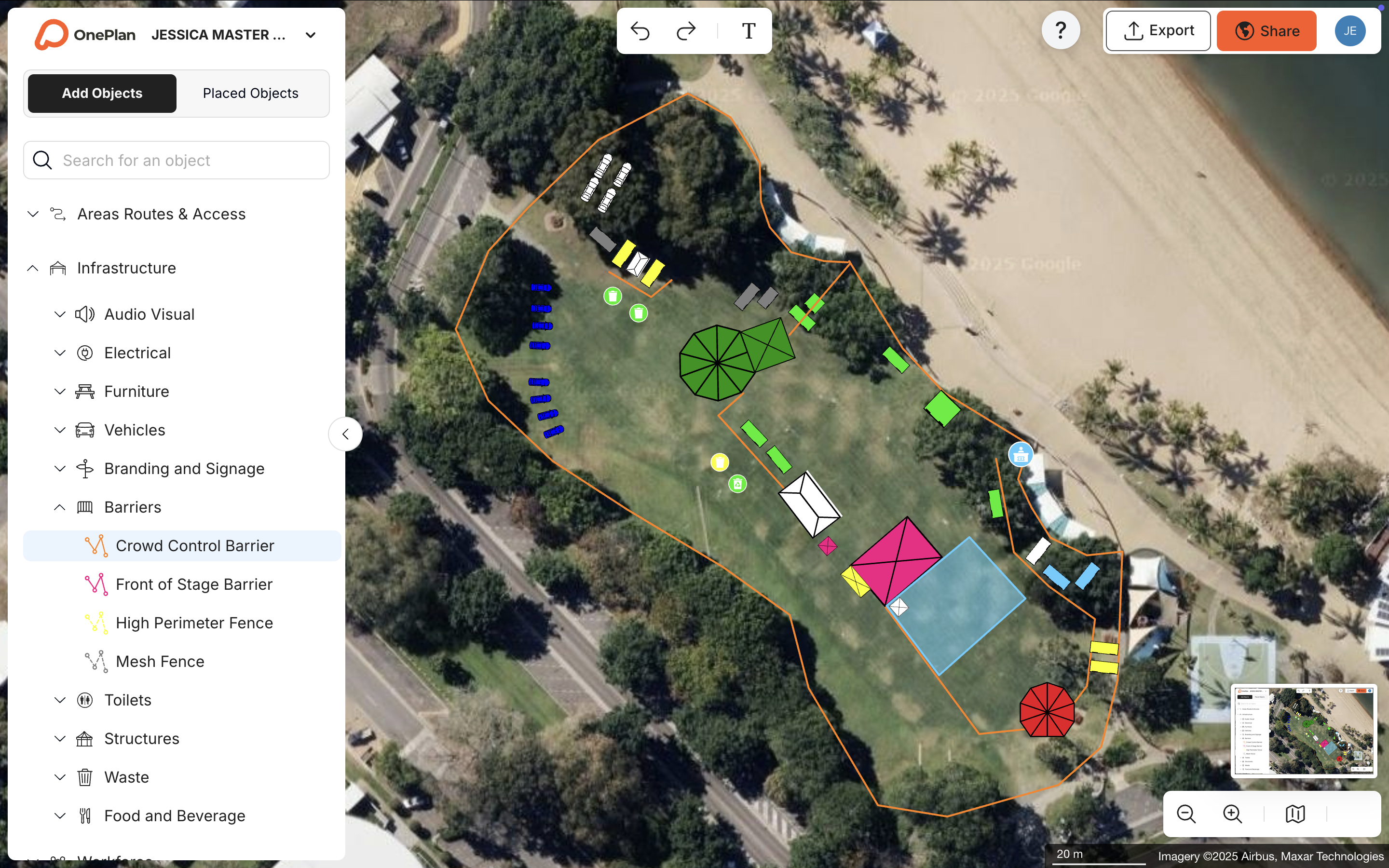
The Cheese & Chilli Festival case mentioned earlier shows how this workflow reduces time spent on risk assessments while producing documentation that satisfies stakeholders and licensing authorities across multiple events per year.
Your first event is free, with up to 25 objects and no payment details required. Start placing objects on your map today with your first event free, or book a 15-minute demo to see the full OnePlan platform.
Conclusion
A crowd safety plan template for an outdoor festival only delivers value when it produces a practical, accurate plan. Static checklists and PDF exports from PowerPoint do not confirm whether your capacity math is correct, whether your security posts cover the right zones, or whether your evacuation corridors are wide enough. A to-scale, map-based plan answers those questions.
The four sections in this guide, covering site layout and capacity, security and crowd spotters, emergency and medical response, and communication and weather, give you the structure regulators and insurers expect. OnePlan provides the tools to build that structure on a live map, calculate safe standing capacity, place every staff member and infrastructure item accurately, and export a permit-ready document the same day.
Frequently Asked Questions
What should a crowd safety plan for an outdoor festival include?
A complete outdoor festival crowd safety plan covers four core areas. Site layout and standing capacity require a to-scale map showing all zones, barriers, and entry and exit points. Security and crowd spotter deployment covers staffing ratios, post assignments, and supervisor structure. Emergency and medical response includes first-aid post locations, vehicle access routes, evacuation corridors, and assembly points. Communication and weather protocols document PA scripts, multi-channel alert systems, weather trigger thresholds, and show-stop authority. Licensing authorities and insurers increasingly expect all four sections to be documented before an event license is granted. Requirements vary by state and local jurisdiction, so always confirm what your specific authority requires.
How do I calculate safe standing crowd capacity for an outdoor festival?
Safe standing crowd capacity starts with your gross site area in square feet. Subtract all non-audience space such as stages, production zones, vendor footprints, first-aid posts, and any area without a direct sightline to the stage. Apply a target standing density to the remaining usable area to get your safe capacity figure. Build in a buffer by stopping entry at around 80% of calculated capacity to create a safety margin for unexpected surges. OnePlan's crowd capacity calculator lets you outline any standing area on a to-scale map and returns a safe capacity figure instantly, giving you a defensible number for permit submissions. Use OnePlan's free arrival and exit calculators to validate your gate configuration against your peak arrival window and evacuation timeline.
What security and medical staffing ratios apply to outdoor festivals?
No single universal ratio applies to every event. Final numbers depend on crowd profile, alcohol licensing, event duration, and local authority requirements, which vary by state and jurisdiction. As a starting point, industry guidance commonly references 1 security guard per 25–50 guests for high-energy outdoor festivals, 1 steward per 100–150 attendees for higher-risk outdoor music events, and 1 EMT per 500–1,000 attendees with at least one ambulance on site for events exceeding 2,500 people. Events with alcohol present typically require a 20–30% increase in security staffing. Medical cover must be provided by a dedicated clinical team, and security and stewarding staff should not be relied on as medical responders. Always confirm ratios with your local licensing authority and event safety advisors.
What should a severe weather plan for an outdoor festival include?
A severe weather plan should name separate individuals responsible for weather monitoring and show-stop authority, set trigger thresholds tied to actual evacuation timelines for each crowd zone, and include pre-scripted PA messages for watch, warning, shelter, evacuation, and all-clear scenarios. Communication should use multiple channels, including PA, LED screens, push notifications, SMS, and social media, with physical signage as a fallback. The 30/30 Rule is a widely used lightning safety benchmark: seek shelter immediately if lightning is seen and thunder heard within 30 seconds, and wait at least 30 minutes after the last thunder before resuming. Consulting a professional meteorologist is advisable for larger events. The National Weather Service offers a free hazardous weather planning service for outdoor events when a form is submitted at least two weeks in advance.
How does OnePlan help festival site managers produce compliant crowd safety documentation?
OnePlan is a browser-based event site planning platform that replaces static screenshots and spreadsheets with a to-scale, collaborative plan on a live satellite map. Festival site managers use it to outline crowd areas and calculate safe standing capacity instantly, place security staff, medical posts, barriers, and fencing accurately to scale, and model ingress and egress flow using the free arrival and exit calculators. They also export a high-resolution map for permit submissions alongside an auto-generated Bill of Quantities for suppliers. Because every team member works from the same live plan, version-control issues and last-minute compliance risks are significantly reduced. The first event is free, with up to 25 objects and no payment details required, so you can start placing objects on your map within seconds.