
Written by: Paul Foster, Founder, CEO, OnePlan
Key takeaways for public market planners
- A public market can mean either a financial exchange or a physical community marketplace, and this guide focuses on the recurring, in-person events that require detailed site planning.
- Physical public markets feature vendor stalls, fresh goods, and community programming, with examples like the Rochester Public Market operating year-round across a dedicated district.
- Effective planning covers vendor placement, crowd flow, parking, utilities, and permit-ready documentation, which static tools often struggle to support accurately.
- OnePlan brings these tasks into one place with to-scale layouts, capacity calculations, and exportable permit documents in a single collaborative platform.
- Event organizers can see the platform in action to understand how OnePlan simplifies public market planning from concept to execution.
Two meanings of “public market”
The term “public market” carries two distinct meanings depending on context. In everyday community life, a public market is an open-air or indoor venue where vendors sell produce, prepared foods, handmade goods, and crafts to the general public. In financial and economic contexts, the same phrase refers to regulated exchanges where securities are bought and sold by institutional and retail investors.
For local-government planners, parks-and-recreation staff, and festival coordinators, the physical definition is usually the one that matters. A public market in this sense is a temporary or recurring event that occupies a defined physical space, such as a park, a parking lot, a town square, or a dedicated market hall. It demands the same operational rigor as any large community gathering.
Public market meaning in finance
In finance, a public market is a regulated marketplace where securities such as stocks, bonds, and exchange-traded funds are listed and traded by the general investing public. Examples include the New York Stock Exchange and the Nasdaq. Access is open to any qualified buyer or seller, prices are publicly disclosed, and trading is governed by federal regulators such as the Securities and Exchange Commission.
This meaning is entirely separate from the community-event definition. A financial public market has no vendor stalls, no crowd-flow challenges, and no permitting requirements for portable restrooms. The two definitions share a name and little else. To clarify which definition applies to your work, the comparison below sets all three market types side by side.
Public market vs private market vs community market
The table below separates the two financial-market types from the physical community marketplace, so organizers researching the term can quickly identify which definition fits their planning needs.
| Dimension | Physical community market | Financial public market | Financial private market |
|---|---|---|---|
| Purpose | Sell food, crafts, and goods directly to the public | Trade publicly listed securities (stocks, bonds, ETFs) | Raise or trade capital outside public exchanges |
| Participants | Local vendors, community visitors, event organizers | Retail and institutional investors, brokers | Accredited investors, private equity, venture capital |
| Regulation | Local permits, health codes, fire and safety approvals (varies by state/city) | Federal oversight (e.g., SEC in the U.S.) | Limited public disclosure, SEC Regulation D exemptions |
| Planning requirements | Site maps, vendor layout, crowd flow, road closures, infrastructure coordination | Listing requirements, prospectus filings, compliance reporting | Investor agreements, due diligence, private placement documents |
The rest of this guide focuses exclusively on the physical community market and what it takes to plan one well.
Examples of physical public markets
Physical public markets share a recognizable set of characteristics. They feature open-air or covered vendor stalls, a mix of fresh produce, prepared foods, and artisan goods, and a recurring or seasonal schedule that builds community loyalty over time. A common vendor mix for farmers markets balances produce, prepared foods, and crafts, which preserves the market’s core identity while keeping the experience varied.
The Rochester Public Market in Rochester, New York, is one of the largest and longest-running public markets in the northeastern United States. It operates year-round with hundreds of vendors across a dedicated market district. City-sponsored weekend markets have expanded in several U.S. municipalities in recent years, and parks-and-recreation departments increasingly treat them as anchor community events that require the same planning discipline as festivals and fairs.
Each of these events functions as a temporary site-planning project. Vendors must be placed, utilities confirmed, crowd routes mapped, and emergency access preserved, all before a single stall opens.
Start planning your market site for free — OnePlan’s first event is on us, with no credit card required.
How to plan a physical public market site
Planning a physical public market introduces several overlapping operational challenges that static tools like PowerPoint, Excel, or Google Maps screenshots rarely solve well.
Vendor placement and spacing. Each vendor booth requires space allocation, with additional room for walkways and amenities such as seating, restrooms, and demonstration areas. Once you confirm the footprint for each booth, the next step is strategic placement. Grouping similar vendors while spacing direct competitors improves customer flow and reduces friction. To help vendors find their assigned locations on event day, each spot should be clearly marked and labeled with booth numbers that match the layout map.
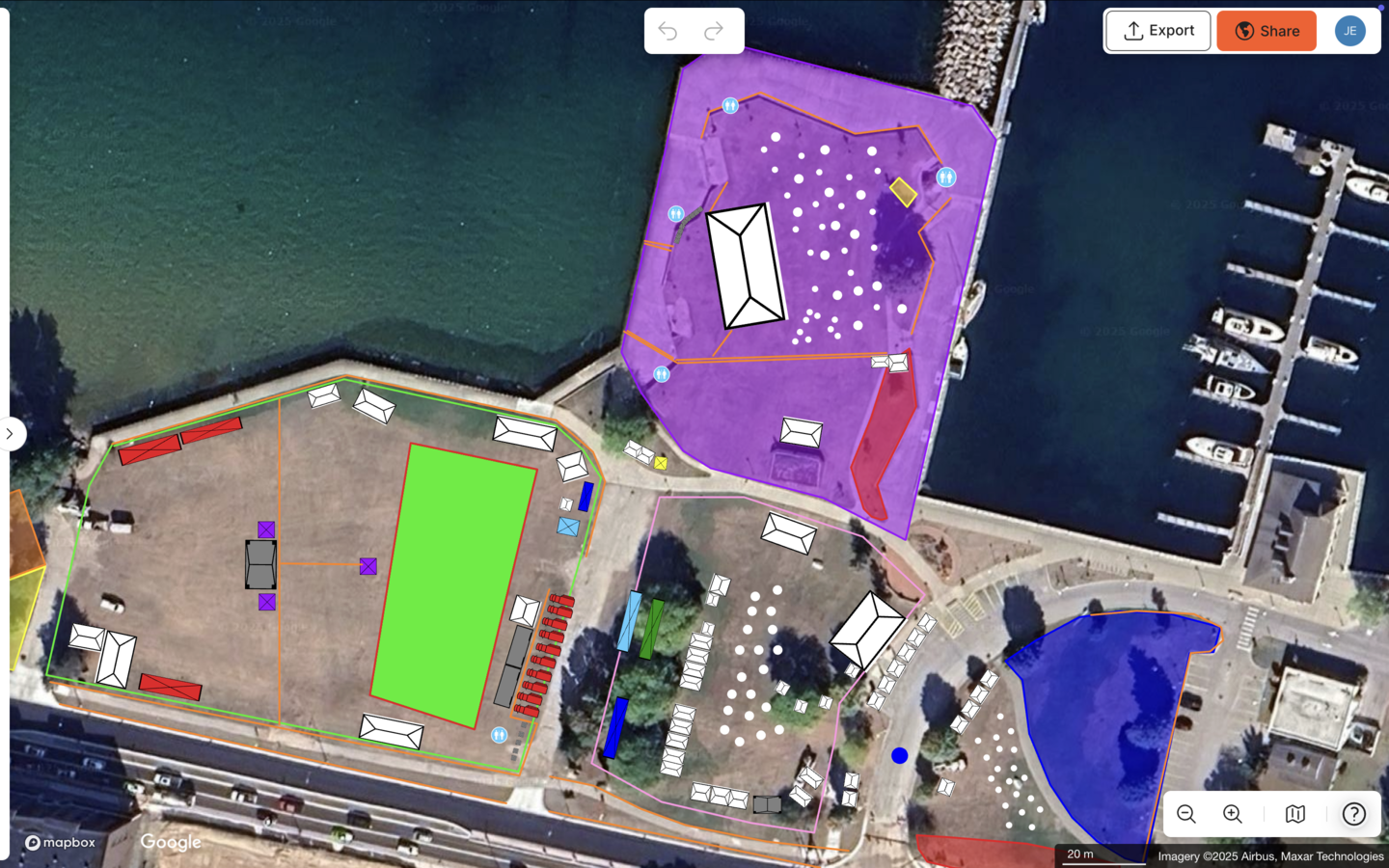
Crowd flow and ingress/egress. Bottlenecks at entrances and exits are among the most common operational failures at recurring markets. Monitoring flow during market hours and planning overflow routes in advance reduces the risk of congestion that can trigger safety incidents or permit complications. OnePlan’s free arrival calculator and exit calculator estimate queue length, queue time, and exit capacity based on crowd size and exit width, which gives organizers defensible numbers before event day.
Parking. Market planners should allocate sufficient parking with ADA-compliant spaces and clear pedestrian routes from parking areas to each market entrance. Signage and staff support at key crossings help visitors move safely between vehicles and vendor areas.
Infrastructure and utilities. Food vendors need reliable power access and produce vendors need water access, so both should be confirmed during site selection. Electrical hookups must be tested before vendors arrive. Tent weights per leg are a standard safety requirement at many markets, and planners should communicate those standards clearly in vendor guidelines.
Permit-ready documentation. Local-government approvals, road-closure requests, and fire-marshal sign-offs all require accurate, to-scale site maps. A plan built in PowerPoint or sketched on paper rarely meets that standard. Requirements vary by city and state, so always confirm expectations with your local permitting authority.
The OnePlan workflow for public market site planning:
- Choose a map base (Google Satellite or street map) and zoom to your market site.
- Import any existing sketches, GIS layers, or floor plans as .png files and scale them onto the map.
- Drag to-scale objects, such as vendor tents, crowd barriers, portable restrooms, parking areas, generator placements, and signage, directly onto the map. Every object stays accurately to scale as you zoom.
- Use the area calculator to confirm each vendor zone fits within its allocated footprint.
- Use the standing crowd capacity calculator to outline pedestrian areas and confirm safe occupancy levels.
- Run the arrival and exit calculators to model ingress and egress flow.
- Generate a Bill of Quantities, an auto-exported inventory of every object on the map, for procurement and contractor coordination.
- Export a high-resolution map (up to A0, print-ready) for permit submissions and stakeholder presentations.
Parks-and-recreation staff, public-works teams, police, fire, and vendors can all work from the same live plan instead of maintaining separate versions. Eagle Mountain City, a local-government customer, cut event planning from 8–10 hours down to a few hours per event and reported a 5x return on investment after replacing fragmented tools with OnePlan. As their Events Manager put it, “Gone are the days of creating separate layouts for fire, police, facilities, and other departments. Now I can create a single, all-encompassing layout.”
Watch OnePlan turn your market sketch into a permit-ready map in a 15-minute walkthrough.
Frequently asked questions about public markets
How many physical public markets operate in the United States?
The number of physical public markets in the United States runs into the thousands when farmers markets, city-sponsored weekend markets, and permanent market halls are counted together. The USDA has tracked over 8,000 farmers markets operating across the country in recent years, and that figure does not include the broader category of craft markets, food halls, and community markets organized by parks-and-recreation departments. Many U.S. cities now operate multiple recurring markets across different neighborhoods throughout the year.
How does planning a physical public market differ from a financial exchange?
Planning a physical public market is an operational and spatial challenge. Organizers must design a site layout, coordinate vendor placement, manage crowd flow, arrange utilities, and secure local permits. A financial exchange, by contrast, is a regulatory and compliance environment governed by federal law. It has no physical site to lay out, no vendor tents to place, and no crowd-capacity calculations to run. The two share a name but require entirely different skill sets and tools.
Which U.S. cities host large recurring public markets in 2026?
Several U.S. cities are well known for large, established public markets. The Rochester Public Market in New York operates year-round and draws hundreds of vendors. Pike Place Market in Seattle is one of the oldest continuously operating public markets in the country. The Eastern Market in Detroit and the Reading Terminal Market in Philadelphia are major indoor market halls with significant vendor communities. City-sponsored weekend markets have also expanded in municipalities across the Sun Belt and Pacific Northwest in 2025 and 2026, with parks-and-recreation departments taking a more active role in organizing and permitting them.
How can organizers estimate safe crowd capacity?
Crowd capacity estimation should always reflect the specific conditions of your site, including surface type, exit widths, layout, and local regulatory requirements, rather than generic benchmarks. OnePlan’s standing crowd capacity calculator lets organizers outline any area on the map and instantly see its capacity based on a selectable people-per-square-meter density. This produces a defensible figure that can be shared with permitting authorities. For flow planning, OnePlan’s free arrival calculator and exit calculator model queue length, queue time, and exit throughput based on your crowd size and site configuration. Always confirm capacity requirements with your local fire marshal or relevant authority, as standards vary by state and municipality.
Conclusion: Bringing public market planning into one live map
A public market means something very different depending on whether you read a finance textbook or plan a community event. For local-government planners, festival coordinators, and parks-and-recreation staff, the physical public market is a recurring site-planning project with real operational stakes. Vendor layout, crowd flow, utility coordination, road closures, and permit-ready documentation all have to come together before the first stall opens.
OnePlan replaces a fragmented mix of presentation files, spreadsheets, design tools, and static screenshots with a single, browser-based platform where every stakeholder works from the same to-scale, live map. From dragging vendor tents onto a satellite base to generating a Bill of Quantities for your contractors, the entire planning workflow lives in one place, and your first event is free.
Start your first market plan free or schedule a demo to see the full workflow.