Written by: Paul Foster, Founder, CEO, OnePlan | Last updated: July 6, 2026
Key Takeaways for Safer, Smoother Events
- Coordinating event plans with police and fire means aligning site layout, safety zones, access routes, and emergency protocols with all responding agencies before barriers go in.
- The process covers permit applications, joint planning meetings, unified command setup, communication protocols, and a final pre-event briefing to avoid last-minute rejections.
- Using one live, to-scale digital site plan shared across agencies removes version chaos and helps emergency vehicles reach the right locations quickly.
- Early stakeholder identification, 90+ day lead times, and structured after-action reviews improve approvals and future event coordination.
- OnePlan provides a single source of truth that unifies police, fire, and event teams. See how it streamlines multi-agency planning.
8-Step Checklist: How to Coordinate Event Plans with Police and Fire
- Identify every agency stakeholder early. List police, fire, EMS, public works, and any local Office of Emergency Management contacts before you begin planning.
- Start the conversation at least 90 days out. Most jurisdictions require permit applications weeks or months in advance, and larger events need even more lead time. Requirements vary by state and locality.
- Build one to-scale digital site plan. Place all infrastructure, including stages, crowd barriers, fencing, first-aid posts, fire lanes, and access roads, on a single live map so every agency sees the same picture.
- Hold a joint planning meeting. Bring police, fire, and EMS to the table with your live plan open. Walk through ingress and egress, emergency vehicle access, exclusion zones, and crowd flow together.
- Define a unified command structure. Agree on who holds incident command authority, who fills each section chief role, and how decisions escalate during the event.
- Set communication protocols and contact lists. Confirm radio channels, clear-text terminology, and a single point of contact for each agency. Distribute the list to all supervisors.
- Verify permits, inspections, and pre-event briefings. Confirm every required permit is issued, walk the site with fire and police, and run a final briefing with all agency leads the morning of the event.
- Conduct an after-action review. Within 72 hours of the event, gather all agencies to document what worked, what did not, and what changes the plan needs for next time.
Start your first event free, or schedule a walkthrough to see how OnePlan unifies your agencies.
Which Agencies Must Coordinate on Your Event Plan
Objective: Identify every stakeholder who must review and approve the site plan before the event can proceed.
Any gathering that requires a special event permit, such as festivals, road races, parades, fireworks displays, concerts, and community fairs, usually needs sign-off from at least one public safety agency. The exact list depends on your jurisdiction, but the core group almost always includes the local police department, fire marshal or fire department, and EMS provider. Larger events add the Office of Emergency Management, public works, traffic engineering, and sometimes state or federal agencies. Requirements vary by state and locality, so confirm the full list with your permitting office early.
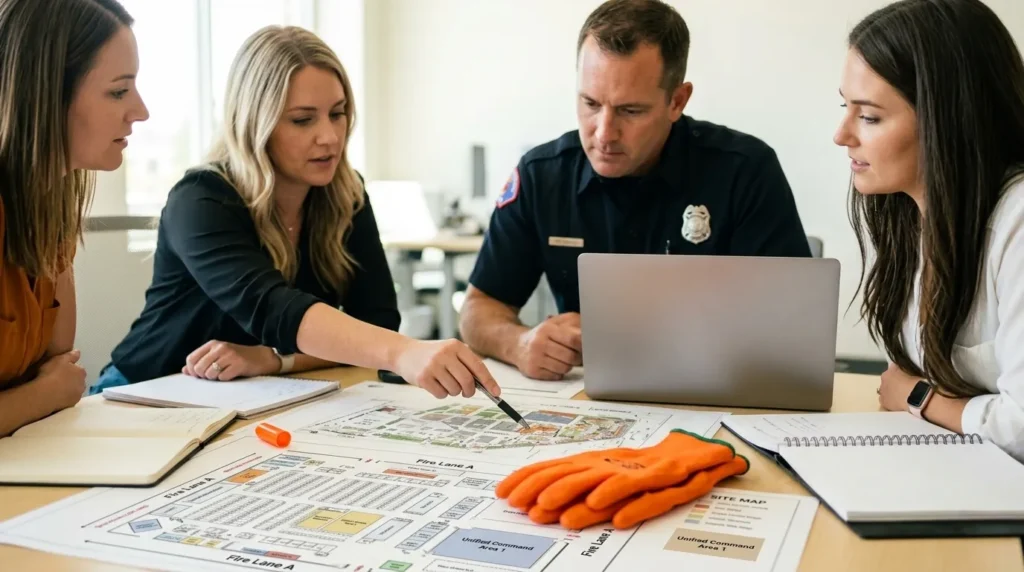
Each agency brings different priorities. Police focus on crowd control, perimeter security, and traffic management. Fire concentrates on access lanes, occupancy limits, hazardous materials, and exit widths. EMS needs clear routes to first-aid posts and staging areas. Eagle Mountain City's Events Manager Dawn Hancock described the old approach this way: "Gone are the days of creating separate layouts for fire, police, facilities, and other departments. Now I can create a single, all-encompassing layout." That shift from separate maps to one shared plan sharply reduces revision cycles.
Success indicator: Every agency stakeholder is identified and listed before the first planning meeting, and no new approver surfaces after permit submission.
When to Start Coordination with Police and Fire
Objective: Set a planning timeline that gives every agency enough lead time to review, request changes, and issue approvals without compressing your build schedule.
A common rule of thumb for mid-size events, roughly 1,000 to 10,000 attendees, is to open dialogue with police and fire at least 90 days before the event date. Events above 10,000 attendees, events on public roads, or events requiring temporary structures typically need 120 to 180 days or more. Requirements vary by state and locality, so check with your local permitting authority for the exact deadlines that apply to your event.
Boston EMS Chief Richard Serino put it plainly: "An incident is not the time to exchange business cards." The same logic applies to planning. Agencies that meet for the first time at a pre-event briefing already lag behind. Early contact builds the personal relationships that Commander Ana Lalley of the Elgin Police Department identifies as the real engine of interagency coordination: "What really gets the work done is personal relationships."
Key decisions: Set a hard date for your first joint planning meeting, confirm the permit submission deadline with your local authority, and work backward so your site plan is ready before that meeting.
Success indicator: Your site plan is substantially complete before the first joint meeting, so agencies react to a real proposal rather than a blank page. Once you reach that point and schedule the meeting within the 90+ day window, the next step is structuring the session to keep every agency aligned.
Running Effective Joint Planning Meetings with Police and Fire
Objective: Run a structured meeting that resolves site-layout questions, assigns responsibilities, and produces a shared record all agencies can reference.
Joint planning meetings work best when every attendee can see the same to-scale site plan in real time. Printed PDFs or static screenshots create ambiguity, because distances look approximate and agencies cannot easily mark up their own requirements. A live digital plan lets the group zoom into the fire lane, measure the gap between a stage and the nearest exit, and confirm that an emergency vehicle can make the turn at Gate 3, all in the same session.
The FEMA Planning P framework, used by Offices of Emergency Management nationwide, structures these meetings around producing an Event Action Plan that serves as the common operating picture for all agencies. A productive agenda covers site layout and infrastructure review, emergency vehicle access and staging, crowd flow and exit capacity, hazardous materials and fire-prevention requirements, and a tabletop walkthrough of likely incident scenarios.
Fire Engineering notes that tabletop exercises before special events expose gaps in interagency plans and coordinate responsibilities such as perimeter security and suspect package handling. These gaps cost far less to fix in a meeting room than on event day.
Success indicator: Every agency leaves the meeting with a copy of the same plan version, a list of agreed action items, and a date for the next review.
Building One Unified Event Safety Plan on a Single Map
Objective: Replace fragmented, agency-specific maps with one live, to-scale digital plan that serves as the single source of truth for the entire event.
Version chaos is the most common source of last-minute rejections. Police have one map, fire has another, and the event organizer has a third. Each was accurate at a different point in time, and none of them match. When the fire marshal arrives for the pre-event inspection and the exit widths on their copy do not match what is on the ground, the event is at risk.
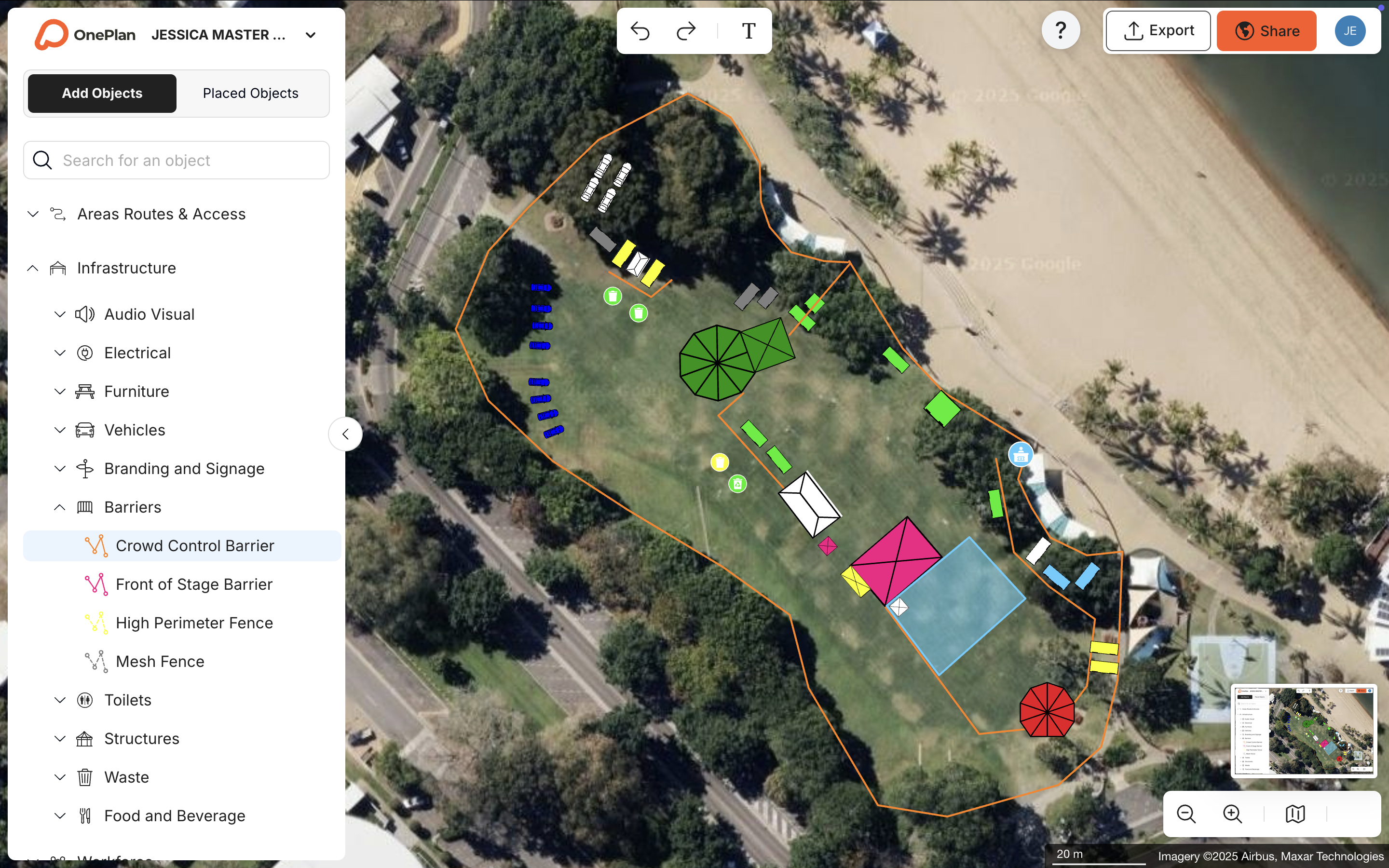
A single live plan solves this directly. This is the shift Dawn Hancock at Eagle Mountain City described earlier, one all-encompassing layout instead of separate maps for each department. Columbus Crew applies the same principle at scale, with team members, contractors, first responders, operations staff, and internal teams all contributing their own layers to a single live plan. The plan stays current because there is only one version to update.
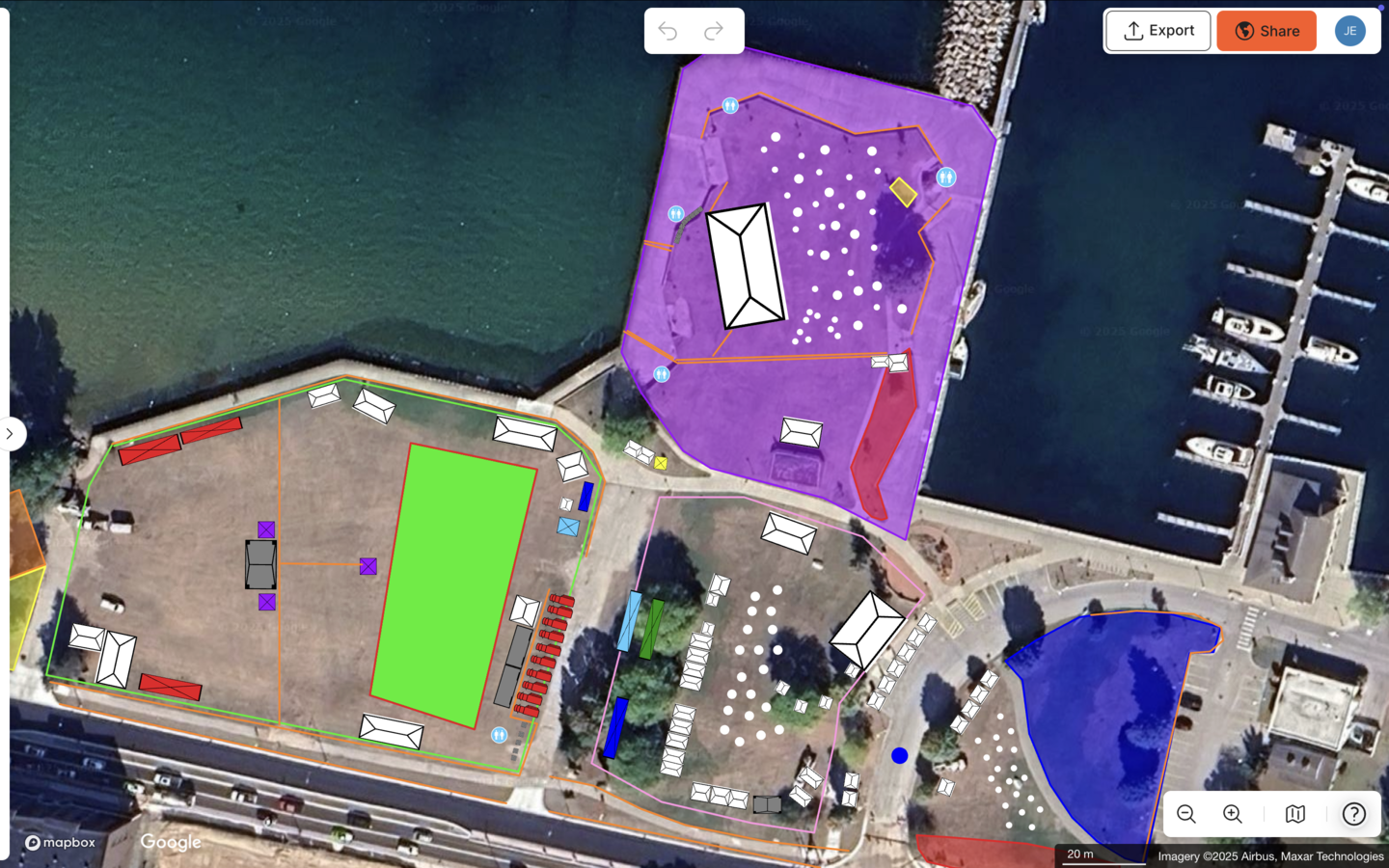
For safety planning specifically, the map needs to show emergency vehicle access routes and turning radii, fire lanes and hydrant locations, crowd barriers and fencing with accurate dimensions, first-aid and medical staging areas, exclusion zones for fireworks, pyrotechnics, or hazardous materials, and all entry and exit points with measured widths. The City of Greater Dandenong's team found that for their New Year's Eve fireworks, OnePlan's measuring tool was invaluable for setting a safe exclusion zone, saving numerous site visits and eliminating inaccurate maps.
Success indicator: All agencies reference the same plan URL or export at every meeting, with no parallel versions in circulation. With that shared map in place, you can then define who leads when the plan becomes a live incident scene.
Defining Roles with a Unified Command Structure for Events
Objective: Establish clear incident command roles before the event so every agency knows who makes which decisions and how authority transfers during an incident.
The Incident Command System, or ICS, is the standard framework for multi-agency event management in the United States. For events involving police, fire, and EMS, a Unified Command structure is typically used, with representatives from each agency sharing command authority rather than one agency directing the others. Research on unified command outcomes shows that the structure succeeds or fails based on pre-event preparation and prior joint work among agency leaders, not on-scene improvisation.
Define key roles in advance. These include Unified Command representatives from each agency, an Operations Section Chief who manages tactical resources on the ground, a Staging Area Manager who controls emergency vehicle positioning, and a Public Information Officer if media access is part of the event. Fire Engineering recommends that every event participant, including fire, police, EMS, parks, and highway departments, receives clear task assignments, communication protocols, and a defined command structure based on ICS.
Document the command chart on the site plan itself, with each role linked to a named individual and a contact number. When the plan serves as the shared reference, the command structure travels with it.
Success indicator: Every supervisor on event day can name their incident commander and their escalation path without consulting a separate document.
Setting Communication Protocols and Contact Lists
Objective: Establish radio channels, terminology, and contact lists that all agencies can use without ambiguity during the event.
NIOSH recommends that fire and law enforcement agencies establish common communications and clear-text terminology that firefighters can use in person or over the radio to notify law enforcement when immediate assistance is needed. For event organizers, this means agreeing on terminology before the event, not improvising it on the day.
A practical communication protocol covers primary and secondary radio channels for each agency, clear-text codes for common situations such as medical emergencies, crowd surges, fires, and evacuations, a single event-day command phone number for each agency lead, and a protocol for notifying the event organizer when an agency escalates its response level.
Emergency management best practice calls for communication systems and liaisons between local emergency responders and relevant agencies to be established in advance, with notification systems regularly tested to confirm they can handle surges. For events, that means a pre-event radio check with all agencies, not just an assumption that channels are working.
Place the contact list on the site plan as a reference layer, and distribute a printed copy to every supervisor. When the plan updates, the contact list updates with it.
Success indicator: All agency supervisors confirm receipt of the contact list at the pre-event briefing, and a radio check is completed before gates open.
Verifying Permits, Inspections, and Pre-Event Briefings
Objective: Confirm that every required permit is issued, every inspection is passed, and every agency lead is briefed before the event opens to the public.
Permit and inspection requirements vary significantly by state and locality. As an illustrative example, California’s Fire Code requires fire safety inspections for temporary structures and large outdoor gatherings, but the specific thresholds and processes differ by county and city. Always confirm requirements with your local fire marshal and permitting office.
The IAFC Special Events Planning Toolkit includes a dedicated Fire Prevention Checklist to help fire chiefs and partner agencies identify, inspect, and manage risks before the event begins, supporting permit and safety verification processes. The toolkit notes it is not intended to replace local plans, code requirements, or policy, but offers flexible checklists adaptable to festivals, concerts, sporting events, and air shows.
Pre-Event Briefing Checklist
The pre-event briefing follows a clear sequence. First verify documentation and layout, then confirm operational readiness, and finally brief frontline personnel.
Documentation and Layout Verification:
- Confirm all permits are issued and on-site copies are available.
- Walk the site with fire marshal and police liaison to verify layout matches the approved plan.
- Confirm emergency vehicle access routes are clear and unobstructed.
- Verify all fire lanes, hydrant access points, and exclusion zones are marked.
Operational Readiness:
- Confirm first-aid and medical staging areas are staffed and equipped.
- Distribute final contact list and radio channel assignments to all supervisors.
- Conduct a radio check with all agencies.
Personnel Briefing:
- Confirm crowd capacity limits and entry control procedures with gate supervisors.
- Brief entry-level personnel, including barricade and traffic control staff, on their specific assignments.
- Confirm escalation procedures and unified command activation threshold.
Success indicator: The fire marshal and police liaison sign off on the site walk before gates open, with no outstanding permit conditions.
Conducting an After-Action Review
Objective: Capture lessons from all agencies within 72 hours of the event while details are fresh, and update the site plan to reflect what actually happened on the ground.
An after-action review, or AAR, is the structured process by which all participating agencies document what was planned, what occurred, and what should change. Fire Engineering identifies the AAR as a core component of special event planning, with findings feeding directly into updated plans and improved interagency coordination for future events. For recurring events, the AAR from year one becomes the starting point for year two.
After-Action Review Template Checklist
- Date, event name, location, and total attendance.
- List of all participating agencies and their representatives.
- Summary of the planned unified command structure versus what was activated.
- Timeline of any incidents, including response times and outcomes.
- Assessment of communication protocols, including what worked, what failed, and what needs updating.
- Site plan accuracy review, including whether the layout on the ground matched the approved plan.
- Permit and inspection findings, including any conditions that were not met or were resolved on the day.
- Crowd flow and capacity observations, including any bottlenecks, surges, or access issues.
- Recommendations for site plan changes before the next event.
- Agreed action items with named owners and deadlines.
- Date of next planning meeting.
When your site plan lives in a single digital platform, updating it after the AAR takes minutes rather than hours. Changes are visible to all agencies immediately, and the revised plan becomes the baseline for the next event cycle.
Success indicator: The updated site plan reflecting AAR findings is shared with all agencies within two weeks of the event, and action item owners confirm receipt.
Frequently Asked Questions
How far in advance should I contact police and fire about my event?
The 90-day guideline for mid-size events assumes a straightforward permit process and a site you control. If your event involves road closures, requires coordination with state or federal agencies, or falls during a busy season when permitting offices have backlogs, add 30 to 60 days to that baseline. The safest approach is to reach out before you think you need to, because agencies appreciate early contact and it builds the working relationships that make approvals smoother.
What should a site plan include to satisfy police and fire requirements?
A site plan submitted for police and fire review should show, at minimum, all entry and exit points with measured widths, emergency vehicle access routes and turning radii, fire lanes and hydrant locations, crowd barrier and fencing layouts with accurate dimensions, first-aid and medical staging areas, exclusion zones for any pyrotechnics or hazardous materials, and the locations of all temporary structures. The plan should be to scale, not a rough sketch, so that agencies can verify distances and access without visiting the site. A live digital plan that all agencies can view simultaneously removes the version-control problems that arise when separate PDFs are emailed to each department.
What is a unified command structure and do I need one for my event?
A unified command structure is an Incident Command System arrangement in which representatives from multiple agencies, typically police, fire, and EMS, share command authority during an event rather than one agency directing the others. It is the standard approach for events involving more than one public safety agency in the United States. Whether your event formally requires a unified command depends on its size, type, and local regulations, but even smaller events benefit from agreeing in advance on who holds incident command authority, who fills each section chief role, and how decisions escalate during an incident. Document the command structure on your site plan so it travels with the plan to every agency.
How do I manage version control when multiple agencies are reviewing the same plan?
Version control breaks down when plans are emailed as static files, because each agency saves its own copy, makes notes on it, and the organizer ends up reconciling several different versions. The solution is a single live digital plan that all agencies access through the same link. When the organizer updates the plan, every agency sees the change immediately without anyone resending a file. For permit submissions and formal approvals, export a high-resolution, dated copy of the plan at each submission milestone so there is a clear record of what was approved and when. OnePlan supports real-time collaboration so every stakeholder works from one source of truth, and exports cleanly to print-ready formats for permit documentation.
How does an after-action review improve future event coordination with police and fire?
An after-action review captures the gap between what was planned and what actually happened on event day while the details are still fresh for all participants. For police and fire coordination specifically, the AAR surfaces issues such as emergency vehicle access routes blocked by vendor vehicles, radio channels that experienced interference, or crowd barriers placed differently than the approved plan showed. When those findings are documented and fed back into the site plan before the next event, each cycle starts from a stronger baseline. Agencies that participate in a well-run AAR are also more likely to engage early in the next planning cycle, because they have seen that their input leads to real changes.
Conclusion
Coordinating event plans with police and fire is a continuous process that runs from the first stakeholder conversation through the final after-action review. Every step in that process, including joint planning meetings, unified command setup, communication protocols, permit verification, and pre-event briefings, works better when all agencies use the same live, to-scale digital plan. Fragmented emails and separate maps are a common cause of last-minute rejections and misaligned layouts. One shared plan removes that problem at the source.
OnePlan has powered more than 200,000 events across 150 countries, from community fairs to the Paris 2024 Olympic Games, and it is free to start for your first event. If you are ready to replace the version chaos with a single source of truth that every agency can access, start your first event free or request a demo to see the platform in action.