
Written by: Paul Foster, Founder, CEO, OnePlan
Key Takeaways
- Martyn’s Law (Terrorism (Protection of Premises) Act 2025) introduces a two-tier system: standard tier (200–799 people) and enhanced tier (800+ people). Each tier requires proportionate counter-terrorism procedures and physical measures at qualifying premises and events.
- Public works teams play a critical coordination role under section 8 of the Act. They manage roads, pavements, parks, traffic management, and emergency access routes that shape crowd flow and security perimeters around venues.
- Key coordination areas for public works include mapping public-realm pinch points, planning emergency vehicle access, aligning capacity assessments with peak attendance, and joining multi-agency training through Local Resilience Forums and ProtectUK resources.
- The article outlines a five-step framework, Assess, Plan, Coordinate, Train, Review, that provides a practical roadmap for public works departments to meet Protect Duty obligations and document compliance efforts.
- OnePlan’s collaborative, to-scale mapping platform helps public works teams, venue operators, police, and emergency services work from a single live plan. Book a 15-minute demo to see how it streamlines Protect Duty coordination.
Understanding Protect Duty (Martyn's Law)
Protect Duty, formally the Terrorism (Protection of Premises) Act 2025, is UK legislation that requires those responsible for publicly accessible premises and qualifying events to put in place proportionate public protection procedures and measures to reduce harm from terrorist attacks.
The Act establishes a two-tier structure based on the maximum number of individuals reasonably expected to be present at the same time, including staff, contractors, and visitors:
- Standard tier (200–799 people): Requires public protection procedures covering evacuation, invacuation, lockdown, and communication. These procedures are expected to be simple and low-cost.
- Enhanced tier (800+ people): Adds physical public protection measures covering monitoring, movement of individuals, physical safety and security, and security of information. Enhanced tier premises must also designate a senior individual responsible for compliance and submit a compliance document to the regulator.
The Security Industry Authority (SIA) is the regulator. It issues compliance notices, penalty notices, and restriction notices. The Home Office published statutory guidance on 15 April 2026 to support implementation. Certain premises, including places of worship and most educational establishments, remain in the standard tier regardless of capacity. Open-access parks and some transport premises are excluded from scope entirely.
Why Public Works Coordination Matters
Public works departments manage the environment immediately surrounding qualifying premises, including roads, pavements, parks, and public realm. These spaces directly affect crowd flow, emergency vehicle access, and physical security perimeters. Under section 8 of the Act, where more than one party shares responsibility for qualifying premises or a qualifying event, they must coordinate with each other so far as is reasonably practicable to meet the Act's requirements.
Even where a public works team is not itself the Responsible Person under the Act, any individual or organisation with some control over enhanced tier premises or a qualifying event must cooperate with the Responsible Person so far as is reasonably practicable. Traffic management decisions, barrier placements, and road closure schedules all sit within that scope. As Bradford Council's guidance notes, "simple actions, clear procedures, trained staff, and well-planned layouts can make a significant difference."
Key Coordination Areas For Public Works Teams
Integrating Public Space With Venue Security
Public works manages the surrounding environment adjacent to qualifying venues. The statutory guidance requires that procedures consider the immediate vicinity, including queues and shared spaces. These areas usually fall within public works jurisdiction. Practical steps follow a simple sequence:
- Start by mapping the public realm around qualifying premises in your area to understand the full crowd environment, including pavements, plazas, and parks.
- Then identify pinch points and shared access routes, along with areas where queues may spill into the highway, so you can see where risks concentrate.
- Finally, coordinate maintenance schedules and roadworks with venue event calendars to avoid conflicts during peak attendance periods.
Planning Reliable Emergency Access
Clear, unobstructed routes for police, fire, and medical responders are essential. Enhanced tier venues must implement physical safety measures including barriers and movement control. These measures require public works input on highways and public realm. Practical steps include:
- Map emergency vehicle access routes to and around qualifying premises, and record any temporary obstructions that could slow response.
- Coordinate barrier and hostile vehicle mitigation (HVM) plans with venue security teams and Counter Terrorism Police advisors so routes remain viable.
- Maintain an up-to-date record of temporary traffic management that could affect emergency response times, and share it with partners.
Aligning Preparedness With Tiers
Capacity assessments under Martyn's Law must be based on peak expected attendance, not average footfall. Public works planners therefore need to consider peak-time conditions when coordinating works, closures, and access routes. A venue with 750 customers and 60 staff on a busy shift has 810 individuals present, which places it in the enhanced tier.
Public works teams should:
- Identify which premises in their area fall into the standard tier (200–799) and enhanced tier (800+).
- Recognise that qualifying public events with 800 or more attendees and controlled access are treated separately from permanent venue capacity. This requires coordination for both the permanent venue and any temporary event setup.
- Tailor traffic management and access planning to the tier, with enhanced tier venues needing more formal, documented coordination.
Building Capability Through Multi-Agency Training
The statutory guidance encourages embedding counter-terrorism preparedness into day-to-day operations and existing health and safety policies, rather than treating it as a standalone exercise, so that staff responses are instinctive and coordinated. For public works teams, this translates into practical training actions:
- Participate in Local Resilience Forum (LRF) exercises, which provide the multi-agency coordination framework under the Civil Contingencies Act 2004.
- Run joint tabletop scenarios with venue security teams and emergency services to test plans and clarify roles.
- Use free resources from ProtectUK, including ACT Awareness e-learning, to build staff awareness without specialist training costs.
Once your team has a baseline of shared training, the next step is keeping everyone aligned on a single, accurate plan for the public realm and venues.
Step-By-Step Coordination Framework
- Assess: Identify qualifying premises and events in your area. Map their tier status using peak attendance figures that include staff. Note which venues fall under the enhanced tier and require physical measures that affect the public realm.
- Plan: Develop joint plans covering emergency access routes, traffic management, and public space integration. Use a single, shared, to-scale map so every stakeholder, including venue operators, police, fire, and highways, works from the same picture.
- Coordinate: Establish regular communication channels with venue Responsible Persons, Counter Terrorism Police advisors, and other agencies. Document your coordination efforts to demonstrate that you have acted so far as is reasonably practicable.
- Train: Integrate counter-terrorism awareness into staff inductions and refresher training. Free government-approved training on ProtectUK, including ACT Awareness (45-minute e-learning) and SCaN (See, Check and Notify), meets the preparedness expectations of Martyn's Law without requiring paid providers.
- Review: Test and update plans regularly. Conduct post-incident and post-exercise reviews, and feed lessons learned into living plans that reflect current conditions.
Roles And Responsibilities In Protect Duty Coordination
How Public Works Fits Into The Response System
Public works professionals do not hold blue-light status like police, fire, and ambulance services, so they are not considered first responders in the emergency services sense. However, under the Civil Contingencies Act 2004, local authorities are Category 1 responders with duties to assess risk and plan for civil emergencies, while utility and transport operators are Category 2 responders with cooperation and information-sharing duties. Public works teams enable response through traffic management, road clearance, and infrastructure maintenance.
The key roles in Protect Duty coordination are:
- Responsible Person: The individual, organisation, or company in control of qualifying premises or a qualifying event. This role holds legal responsibility, although operational tasks may be delegated.
- Designated Senior Individual: Required for enhanced tier premises and qualifying events. This person holds overarching responsibility for compliance within an organisation.
- Security Industry Authority (SIA): The regulator that receives notifications, assesses compliance, and takes enforcement action.
- Counter Terrorism Police: Advisors on protective security measures, including HVM and access control. They coordinate through the local Counter Terrorism Unit.
- Local Resilience Forum: The multi-agency partnership framework for preparation, response, and recovery under the Civil Contingencies Act 2004.
- Public Works: Infrastructure and access enablers. They manage roads, pavements, parks, traffic management, and emergency access routes in the public realm surrounding qualifying premises. With so many roles involved, maintaining a shared, accurate picture of the physical environment becomes essential.
How Digital Tools Support Protect Duty Coordination
The coordination framework above depends on one thing above all else: a shared, accurate, up-to-date picture of the physical environment. That is exactly what OnePlan provides. OnePlan is trusted for 200,000 events in 150 countries, from small community festivals to the Olympics. It is a browser-based platform where public works teams, venue operators, police, fire, and emergency services all work from a single, to-scale, collaborative map.
For Protect Duty coordination, OnePlan supports:
- To-Scale Public Realm Mapping: Place roads, pavements, barriers, crowd areas, and emergency access routes accurately on a live satellite or street map, so every stakeholder sees the real-world picture.
- Traffic Management Planning: Plan road closures, vehicle access points, and pedestrian routing with dedicated traffic management tools. This capability is critical for both standard and enhanced tier coordination.
- Standing Crowd Capacity Calculations: Outline any area and instantly calculate how many people it can safely hold. This supports safe spacing decisions for public spaces adjacent to qualifying premises.
- Real-Time Collaboration: Multiple departments and agencies edit the same live plan simultaneously. This approach removes the version-control problems that come with emailed PDFs and static screenshots.
- Professional Export: Export high-resolution maps and Bill of Quantities reports for Safety Advisory Group meetings, permit applications, and coordination documentation.
Eagle Mountain City in the US cut planning time by 70 percent, from 8–10 hours down to a few hours per event, and achieved a 5x ROI by creating a single, all-encompassing layout shared across fire, police, facilities, and other departments. As Events Manager Dawn Hancock put it: "Gone are the days of creating separate layouts for fire, police, facilities, and other departments. Now I can create a single, all-encompassing layout."
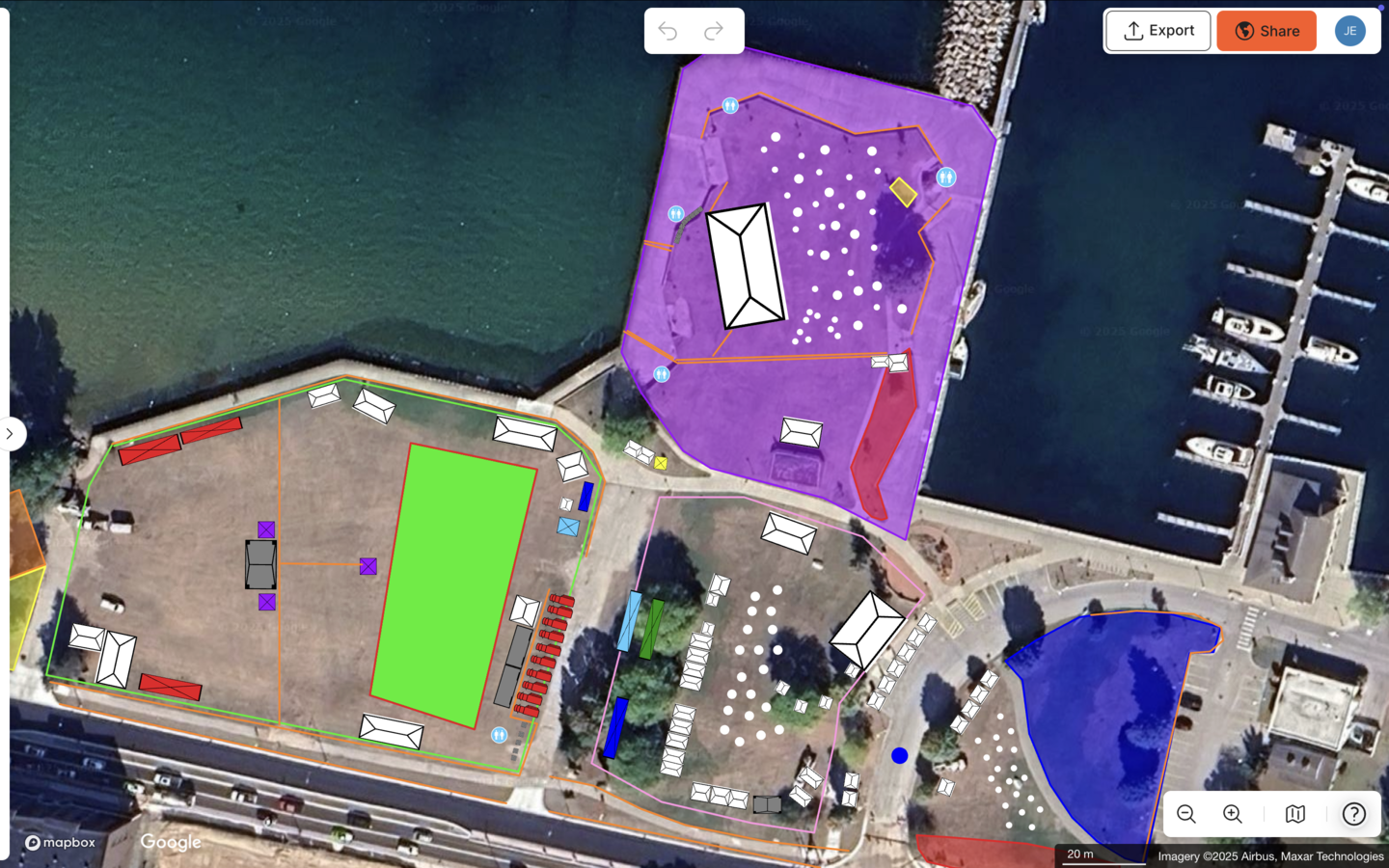
See how OnePlan can streamline your Protect Duty coordination with a focused 15-minute demo.
Common Coordination Challenges And Practical Fixes
Public works teams often encounter recurring obstacles when applying this coordination framework. Each challenge has a practical fix that links back to shared planning and clear communication.
- Siloed Departments: Operations, highways, parks, and emergency planning sometimes maintain separate plans, which creates gaps. Use a shared digital platform where all stakeholders work from one live plan, so a road closure update becomes visible to the venue security team as soon as it is made.
- Outdated Plans: Static PDFs emailed between agencies quickly become out of date, especially as temporary traffic management changes. Maintain living plans that update in real time as conditions change, and apply role-based permissions so the right people can edit while others can view.
- Communication Gaps With Venue Operators: Venue Responsible Persons may not know who to contact in the council, and council teams may not know the right venue lead. Establish regular coordination meetings ahead of peak event periods, and share plans digitally so venue operators can see the public realm context around their premises.
Frequently Asked Questions
What Are The 5 P's Of Emergency Preparedness?
The 5 P's of emergency preparedness form a simple framework used in emergency management to structure planning and response. They are:
- Prevention: Actions taken to avoid an emergency occurring in the first place, such as hostile vehicle mitigation or access control measures.
- Preparedness: Building the capability to respond effectively, including training staff, developing procedures, and conducting exercises.
- Planning: Developing documented, tested plans for evacuation, invacuation, lockdown, and communication, which are the core requirements of Martyn's Law's standard tier.
- Protection: Physical and operational measures that reduce vulnerability, such as CCTV, movement control, and perimeter security, which sit at the heart of the enhanced tier.
- Partnership: Multi-agency coordination across venue operators, public works, emergency services, and local resilience forums to ensure a joined-up response.
Different frameworks use slightly different terminology. The UK government's CONTEST strategy organises counter-terrorism work around Prevent, Pursue, Protect, and Prepare. Always refer to the framework relevant to your specific context and consult the relevant authorities for guidance.
What Is The Difference Between A Responsible Person And A Designated Senior Individual?
The Responsible Person is the individual, organisation, or company that controls qualifying premises or a qualifying event. This role carries the legal duty to comply with Martyn's Law, including putting in place appropriate procedures and measures.
The Designated Senior Individual exists only for enhanced tier premises and qualifying events. This person sits at a senior level within the organisation and holds overarching responsibility for ensuring compliance. In practice, the Responsible Person manages day-to-day implementation, while the Designated Senior Individual provides strategic oversight and accountability.
How Do You Coordinate Public Works With Protect Duty Venues?
Coordination between public works and Protect Duty venues follows the five-step framework described earlier: Assess, Plan, Coordinate, Train, and Review. Start by identifying qualifying premises and events in your area and mapping their tier status. Develop joint plans covering emergency access, traffic management, and public space integration using a shared, to-scale digital planning platform so all stakeholders work from one live map.
Establish regular communication channels with venue Responsible Persons and Counter Terrorism Police advisors, and document your coordination efforts. Integrate counter-terrorism awareness into staff training using free ProtectUK resources. Review and update plans regularly, especially after exercises or incidents. The priority is maintaining a single source of truth that every agency can access and trust.
Conclusion
Martyn's Law places new coordination duties on everyone responsible for publicly accessible spaces, and public works departments sit at the centre of that effort. From emergency access routes to traffic management schemes, and from barrier placement to public realm maintenance, the work public works teams do every day directly affects how well qualifying premises and events can meet their Protect Duty obligations.
The framework is clear: Assess, Plan, Coordinate, Train, and Review. The tools now exist to make this manageable in practice. OnePlan gives public works teams, venue operators, police, fire, and emergency services a single, to-scale, collaborative map to plan from. This approach removes siloed PDFs, version-control problems, and communication gaps that make multi-agency coordination so difficult. As mentioned earlier, OnePlan's track record of 200,000 events in 150 countries shows that it can support complex, safety-critical planning.