
Written by: Paul Foster, Founder, CEO, OnePlan
Key Takeaways
-
Accurate parade barricade counts start with measuring the full route length, then applying a 2× multiplier for both sides plus corner adjustments.
-
Adding a 5–10% contingency buffer prevents shortages from damaged panels, last-minute changes, or added access points.
-
Manual calculations in spreadsheets create version-control issues and slow down permit submissions when routes change.
-
OnePlan measures drawn routes on a to-scale map, generates exact panel counts, and exports a ready-to-share Bill of Quantities.
-
Book a demo with OnePlan to replace spreadsheets with live, permit-ready barricade planning.
Who This Parade Barricade Guide Helps
This guide supports city events coordinators, parks and recreation managers, race directors, and festival organizers who already know their route length and need to convert it into a supplier order quickly. The formula applies to outdoor parade routes in the United States. Specific barricade-placement requirements still vary by city and state, so confirm details with your local permitting authority, police department, and fire marshal before you finalize quantities.
The 4-Step Parade Barricade Calculator Formula
Standard crowd-control barricades, often called bike-rack barriers or steel barricades, are typically 8 feet wide when deployed in a line. The calculation below uses that standard unit length. Adjust the math if your supplier uses a different panel width.
-
Measure total route length in linear feet. Use your event mapping tool or GIS data to capture the full one-way distance from start to finish. A one-mile route equals 5,280 linear feet.
-
Apply the 2× multiplier for both sides, then add corners. Barricades run along both sides of the route, so multiply your linear footage by 2. Add about 8–16 extra panels per intersection or corner to cover the wraparound needed for a continuous barrier line.
-
Add a 5–10% contingency buffer. Damaged panels, last-minute route adjustments, and VIP or media access points all consume extra units. A 10% buffer works well for routes longer than one mile or those with multiple intersections.
-
Multiply by rental rates and add delivery fees. Steel barricades rent at different per-unit daily rates for short-term events, with volume discounts from many suppliers above 200 units. Delivery, setup, and pickup fees typically run $150–$500 per truckload depending on distance and market. Confirm exact figures with your local supplier.
Common Barricade Sizes and 2026 Rental Pricing
The most common parade barricade is the steel bike-rack panel, typically 8 feet wide and 3.5 feet tall. Some suppliers offer 6-foot panels, which help at tighter corners or pedestrian pinch points. Water-filled plastic barriers support vehicle-exclusion zones and usually cost more than steel panels. Confirm with your supplier and permitting authority if any part of your route requires vehicle-rated barriers.
Rental rates for steel barricades vary by supplier and term for short-term events, with monthly and quarterly rates available for longer deployments. Most suppliers offer volume discounts at thresholds of 200, 500, and 1,000+ units, so request a tiered quote if your count exceeds 200 panels. Delivery, setup, and teardown are almost always quoted separately and vary significantly by market and haul distance.
Once you know what type of barricade you need and how suppliers price them, you can focus on turning your route into an accurate order. The next section compares doing that work manually with handling it in OnePlan.
Manual Calculation vs. OnePlan Bill of Quantities
This example shows how the same one-mile parade route looks when calculated manually versus in OnePlan.
Manual process. Measure the route using Google Maps or a wheel. Enter the distance into a spreadsheet. Apply the 2× multiplier, add corner estimates from memory, add a buffer, and calculate a cost. Email the spreadsheet to your supplier. When the route changes, recalculate from scratch, update the spreadsheet, and resend. Version control becomes a problem quickly, and your permit documentation can lag behind the latest draft.
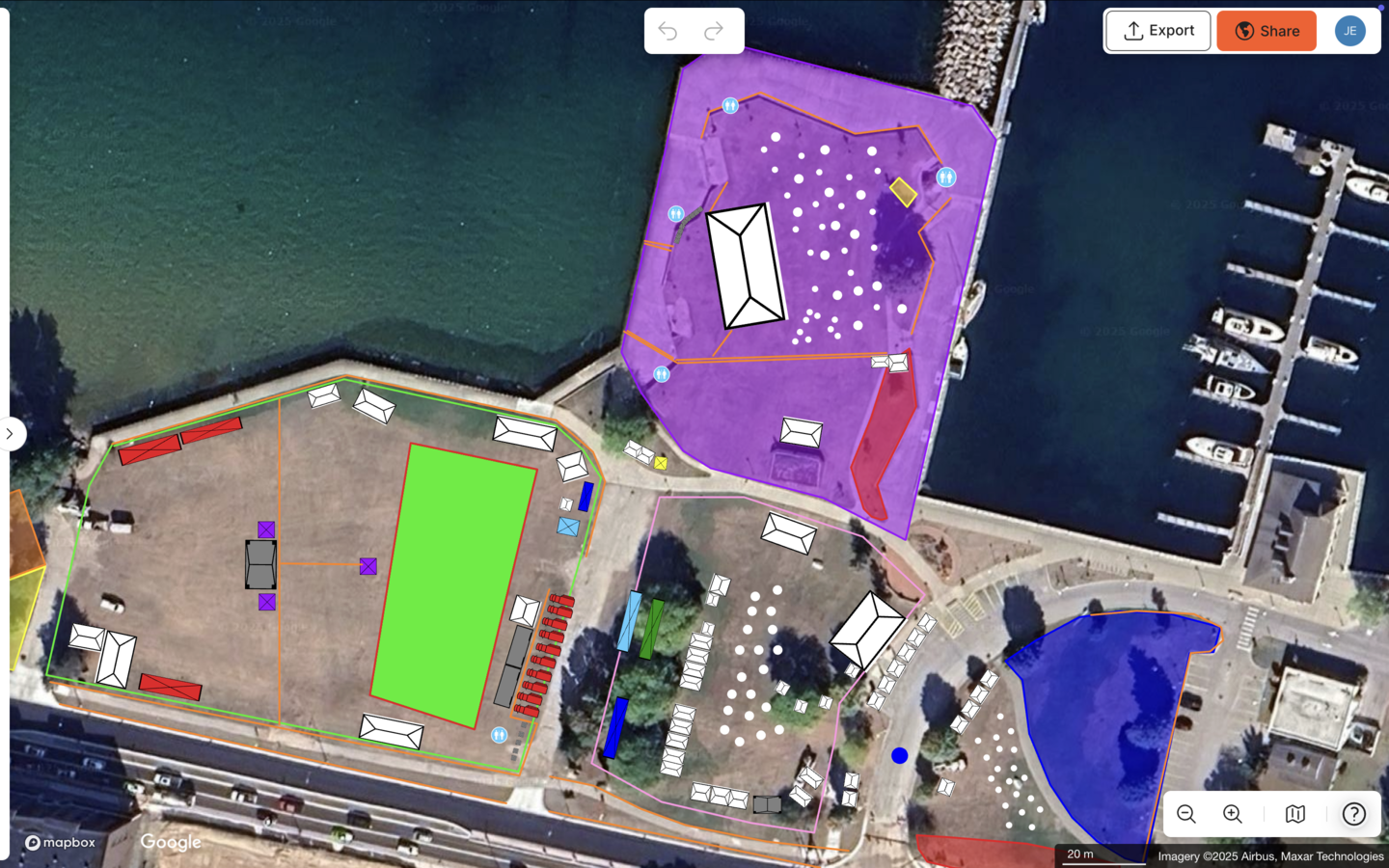
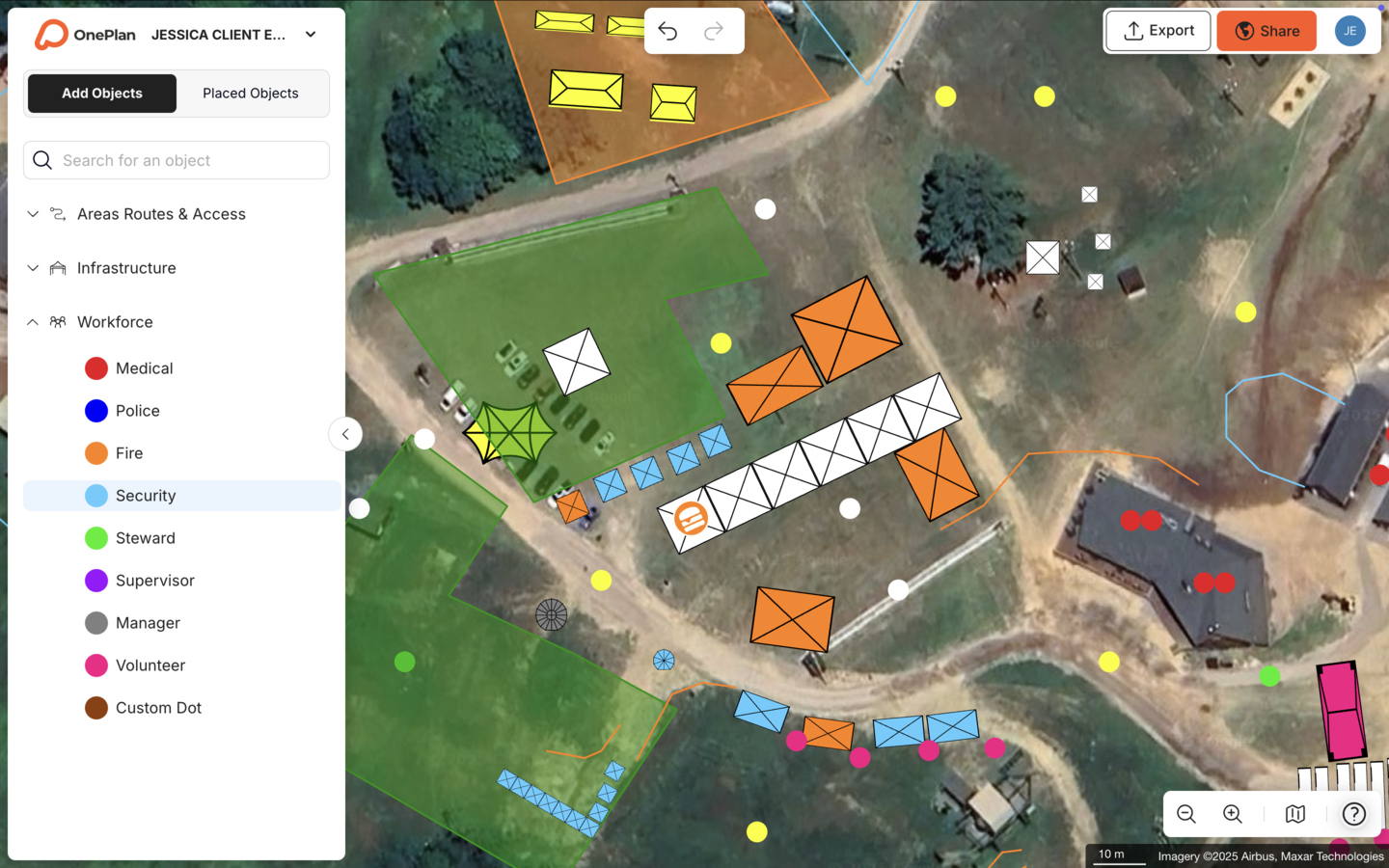
OnePlan process. Draw the route directly on a to-scale satellite map. OnePlan’s pedestrian barrier calculator measures the drawn path, including every curve and turn that a straight-line estimate misses, and automatically generates the panel count. The Bill of Quantities exports that count to Excel or CSV in one click, ready for your supplier and your permit application. When the route changes, redraw the line and the count updates instantly. The Bill of Quantities tool tallies every item placed on the map and calculates infrastructure needs for sourcing from suppliers, so you avoid re-keying.
Bearfoot Productions used OnePlan to calculate and order over 1,000 panels of Heras fencing and 1,500 pedestrian barriers, totaling about 8 kilometers of fencing. That kind of complex order is difficult to get right from a spreadsheet alone. Stadium’s OnePlan-powered platform lets users point and click to generate the exact number of linear crowd-control items needed for a line, which traditional CAD software does not provide.
Using Your Barricade Inventory for Permits and Safety
A barricade count functions as more than a procurement number. It also serves as a safety document. Police, fire, and your local permitting authority need to see that your crowd-control plan is complete, accurate, and current. When your inventory lives in a spreadsheet that circulates by email, version control becomes a liability. The document your fire marshal reviews may not match what your supplier delivers.
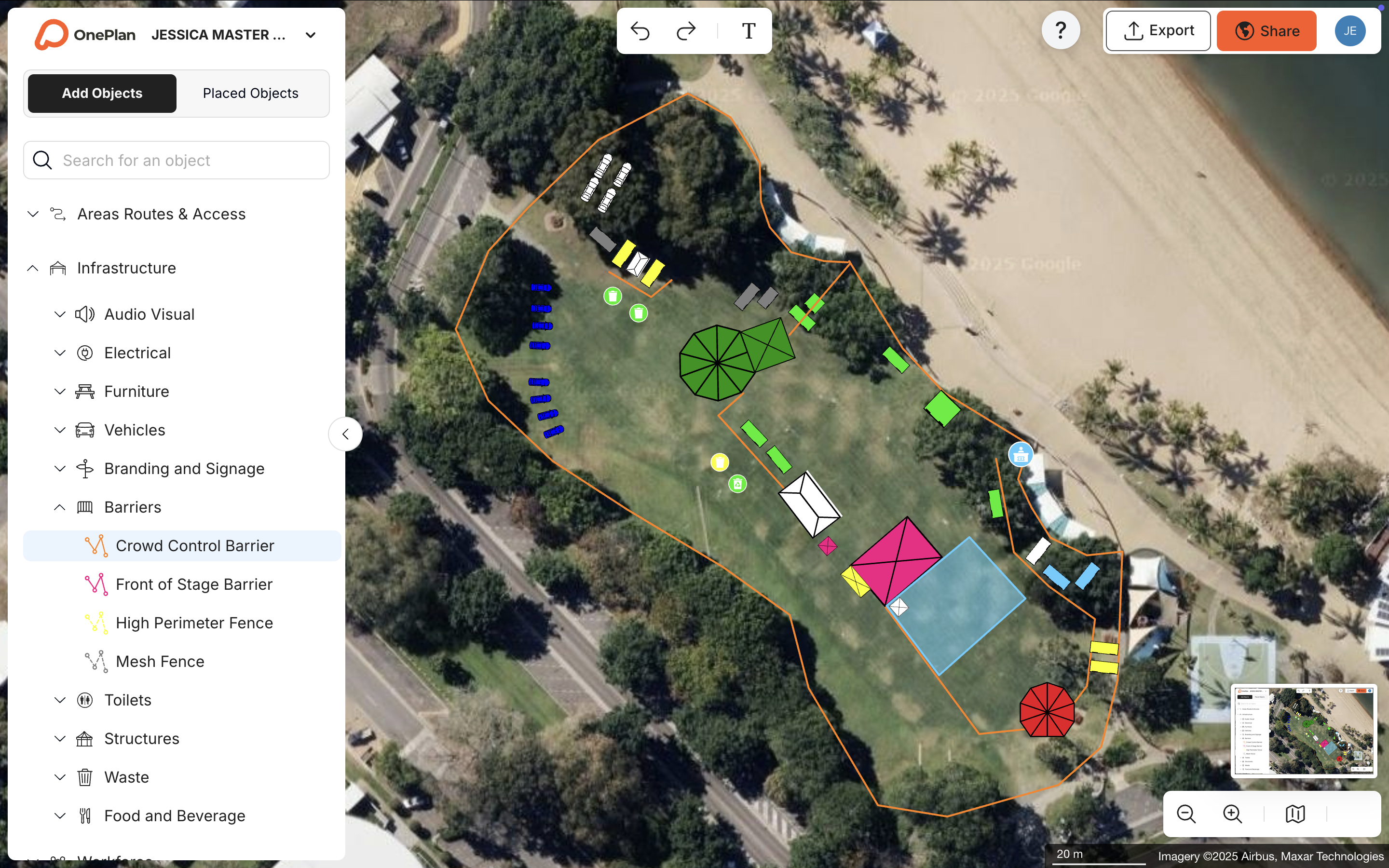
OnePlan keeps everything on one live plan. Operations, your police liaison, the fire marshal, and your barricade supplier all work from the same map. When a route segment changes, the plan updates and the Bill of Quantities reflects it immediately. Exports are high-resolution and print-ready up to A0, so your permit submission looks professional and your safety documentation remains defensible. Festival Foods uses OnePlan’s Bill of Quantities and dashboard reports to calculate and export inventory needs across 11 simultaneous events, and the same approach works for multi-segment parade routes.
Always confirm final barricade placement and quantities with your local permitting authority, police department, and fire marshal. Requirements vary by city and state, and this guide remains illustrative rather than prescriptive.
Parade Barricade Success Checklist
-
Route length measured from a to-scale map, not estimated from memory or a screenshot
-
Both-sides multiplier applied and corner panels accounted for
-
5–10% contingency buffer included in the supplier order
-
Bill of Quantities exported and shared with the supplier before the permit submission deadline
-
Plan version confirmed as current with all stakeholders before event day
-
Fewer pre-event site visits needed because measurements were validated remotely
-
Supplier order matches the final approved layout, with no last-minute additions on the day
Advanced Parade Planning Tactics
Reusing parade templates year over year. If your parade follows the same route annually, save the OnePlan layout as a reusable base. Next year’s planning starts from a finished map rather than a blank canvas. Update road closures, adjust vendor placements, and regenerate the Bill of Quantities in minutes. Eagle Mountain City cut per-event planning from 8–10 hours to a few hours and reported a 5x ROI by moving to a single, reusable plan instead of recreating separate maps for every department each year.
Importing CAD or GIS files. If your city’s public works department or traffic engineering team works in CAD or GIS, you can still build on that work. Convert existing files to .png and import them into OnePlan as a scaled base layer, then draw your barricade lines on top. The Tour of Britain achieved a 75% reduction in site visits and saved 300+ hours per year by moving away from CAD-dependent workflows to OnePlan’s live, collaborative plan. That model translates directly to multi-mile parade routes with complex infrastructure needs.
Planning crowd capacity alongside barricades. After you draw your barricade lines, use OnePlan’s standing crowd capacity calculator to confirm that spectator areas between barriers are sized correctly for your expected attendance. For arrival and exit flow, OnePlan’s free arrival calculator and exit calculator estimate queue length, queue time, and exit capacity based on your crowd size and access-point widths.
Frequently Asked Questions
How do I calculate the number of barricades needed for a parade route?
Measure your total one-way route length in linear feet. Divide by the panel width, typically 8 feet for a standard steel bike-rack barrier, to get the number of panels for one side. Multiply by 2 for both sides of the route. Add 8–16 extra panels per intersection or corner. Then add a 5–10% contingency buffer for damaged units, access points, and last-minute adjustments. For a one-mile route, that method produces about 1,452 panels before delivery and setup costs. In OnePlan, drawing the route on a to-scale map generates this count automatically, including the actual path geometry rather than a straight-line estimate.
What do parade barricades cost to rent in 2026?
Steel bike-rack barricades typically rent at different per-unit daily rates for short-term events, with the actual cost depending on supplier, market, and volume. Monthly and quarterly rates often come in lower per unit for longer deployments. Most suppliers offer volume discounts above 200, 500, and 1,000 units, so request a tiered quote for large orders. Delivery, setup, and teardown fees are almost always quoted separately and vary by market, haul distance, and supplier. Budget $150–$500 per truckload as a starting estimate and confirm with your local supplier.
Do I need different barricade types for different sections of a parade route?
Standard steel bike-rack panels work for most spectator-side crowd control. At vehicle-exclusion points, such as parade start and finish areas, cross-street intersections, or VIP zones, your permitting authority may require vehicle-rated water-filled plastic barriers instead of or in addition to steel panels. Requirements vary by city and state, so confirm the specification with your local police department, fire marshal, and permitting office before you finalize your order. In OnePlan, you can place different barrier types as distinct objects on the map, and the Bill of Quantities will tally each type separately for your supplier order.
How do I handle last-minute route changes without reordering everything?
Last-minute route changes often cause over-ordering or under-ordering. When your barricade plan lives in a spreadsheet, any change means recalculating manually and resending documents, and stakeholders may not receive the latest version. In OnePlan, redrawing a route segment updates the Bill of Quantities instantly. Your supplier, your operations team, and your permitting contacts all work from the same live plan, so the count they see stays current. Building a 10% contingency buffer into your original order also gives you flexibility to absorb small adjustments without a new purchase order.
Can I reuse my parade barricade plan for next year’s event?
Yes. Reusing your plan is one of the biggest time-savers for recurring events. Once your route is drawn and your barricade inventory is confirmed in OnePlan, that plan becomes your template. The following year, open the saved plan, update any road closures or vendor placements that changed, and regenerate the Bill of Quantities. You start from a finished, permit-ready layout rather than a blank map. Eagle Mountain City achieved the 70% time reduction mentioned earlier by adopting this reusable-template approach across its annual community events.
Conclusion: Turn Route Length into a Supplier Order Faster
The four-step formula in this guide, measure, multiply, buffer, and price, gives any parade organizer a defensible barricade count from a known route length. Applied manually, it still requires a spreadsheet, careful version control, and a fresh calculation every time the route changes. Applied in OnePlan, it takes minutes. Draw the route on a to-scale map, let the pedestrian barrier calculator handle the math, and export a permit-ready Bill of Quantities directly to your supplier.
OnePlan has powered more than 200,000 events in 150 countries, from one-off community parades to the Paris 2024 Olympic Games. The same tools that help a race director calculate 8 kilometers of fencing for a 10,000-capacity festival work just as well for a city events coordinator planning a two-mile holiday parade. Your first event is free.